What we do: our Social Brainport Agenda
The Social Brainport Agenda aims to promote equal opportunities for everyone. It sets out the priorities and objectives we have identified together with our members. Through four interlinked programme strands – WERKT, FIT, VERBINDT and INNOVEERT – we are working to achieve structural impact in the region.
Our programme areas
Through the Social Brainport Agenda, we demonstrate, for each programme area, how we are contributing to the challenges facing our region. The Social Brainport Agenda comprises:
WERKT – Everyone plays their part
Everyone should have the opportunity to build a secure life. We recognise that there are still people who need help finding a suitable place to learn or work. We are building inclusive workplace cultures, new pathways into work and connections between employers and labour market partners. So that everyone who wants to work can do so.
Read more about WERKTFIT – Everyone can take part
To be able to participate in society, it is important to have the basics in place. This includes being financially secure, being able to read and do maths well, speaking the language and having digital skills. We strengthen financial resilience, basic skills and health, so that people can participate in a sustainable way.
Read more about FITVERBINDT – Everyone looks out for one another
Economic growth in Brainport is changing the region’s demographics. This has implications for social cohesion. Brainport voor Elkaar is committed to bringing different groups and organisations together. We connect employers, employees and community organisations through volunteering, mentoring schemes and long-term partnerships.
Read more about VERBINDTINNOVEERT – Social innovation for everyone
We use technology and innovation to tackle social issues more intelligently, more quickly and on a larger scale. Companies and organisations work together and share their knowledge to develop social innovations.
Read more about INNOVEERT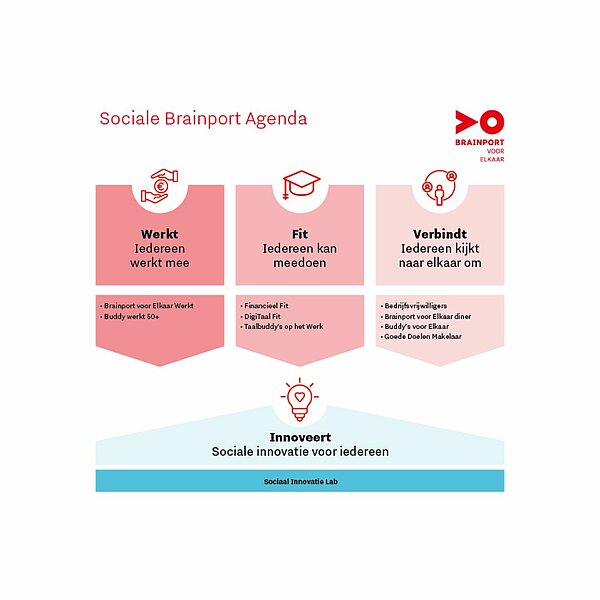
Our four programme strands form the foundation of our activities, but our approach is never compartmentalised. On the contrary: we take a cross-thematic approach, because residents and staff do not live in silos. An employee experiencing financial stress often also has language difficulties, health problems or job insecurity. A young person struggling at school benefits from connections within the neighbourhood as well as from employers who offer opportunities. And an international employee who does not feel at home benefits from buddies, language support and social technology.