Brainport entrepreneurs: “Don't wait, move forward”
Eindhoven – Wars, geopolitical tensions, export restrictions and the technological race between the United States and China are putting pressure on the global economy. Other continents are investing heavily in innovation and strategic autonomy. What does that mean for the Netherlands and Europe? And what can entrepreneurs themselves do to remain agile and resilient? Three entrepreneurs from the Brainport region are unanimous in their opinion that waiting is not an option. We must move forward!
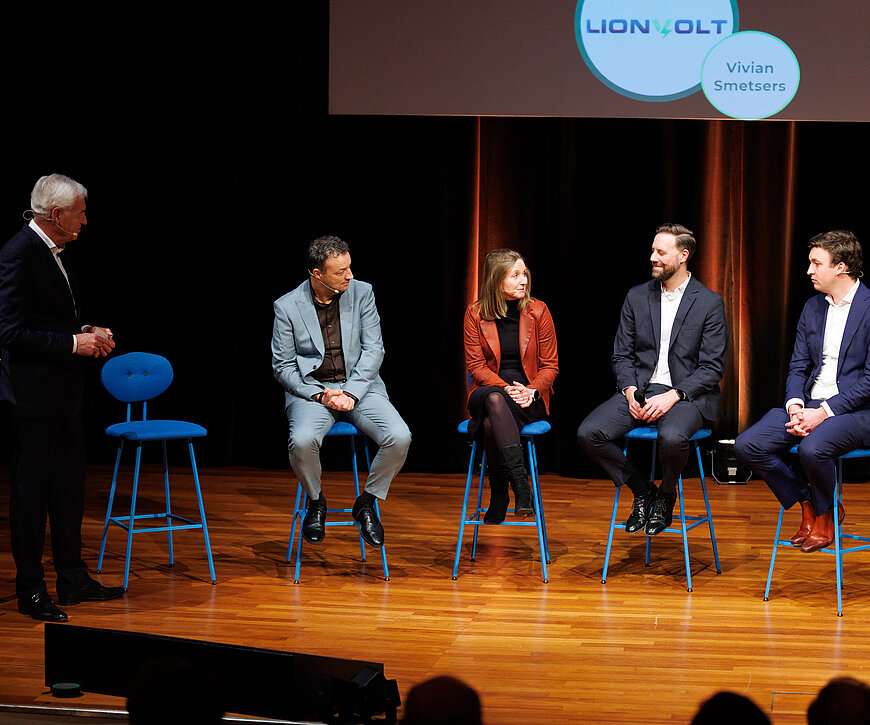
During the preliminary programme of Brainport's New Year's meeting The New Horizon, which took place on Tuesday 6 January, chairman Marc Hendrikse spoke with Ton van Mol (Managing Director Holst Centre), Tijn Swinkels (CEO DENS), Albert Maas (CEO Avular) and Vivian Smetsers (CFO LionVolt). In a panel discussion, they shared their views on the impact of geopolitical shifts on businesses and showed how forward thinking, innovation and entrepreneurship not only protect against risks, but also create new opportunities.

Value chains as the foundation of economic strength
A key conclusion from the discussion was that industrial value chains are under pressure, but at the same time are the key to economic earning power. According to Ton van Mol, high-tech value chains offer the greatest added value. The Brainport region has a unique position in this regard, with strong ecosystems around semiconductors, photonics and battery technology, among other things.
However, this position cannot be taken for granted. Europe cannot do everything itself and must make tough choices. Which technologies are strategically crucial? And where can Europe distinguish itself? Only by investing in a targeted manner and continuing to innovate can a strong negotiating position be established with other continents.
Ton van Mol: ‘Strategic autonomy does not mean doing everything yourself, but having a strong position in key technologies.’

Batteries: strategic, innovative and sensitive
Battery technology was mentioned several times as an example of both opportunities and risks. Vivian Smetsers outlined how LionVolt is focusing on innovative anode technology to enable batteries with much higher energy density. By specialising in one crucial link in the chain, the company is building a unique, internationally relevant position.
At the same time, Tijn Swinkels warned against the dependence on Chinese batteries in European energy systems. While the United States has already largely banned Chinese batteries due to safety and cyber risks, Europe is still using them on a large scale. According to Swinkels, this calls for greater awareness among governments and network operators and for acceleration towards European alternatives, especially for critical infrastructure.
Tijn Swinkels (DENS): ‘Batteries are an integral part of critical infrastructure. So you really have to ask yourself how wise it is to place that dependency entirely outside Europe.’

Robotics and drones: a necessity due to labour shortages
Robotics and drones were also mentioned as key technologies for the future. Albert Maas emphasised that China is far ahead in this area, thanks to a clear long-term strategy and large-scale investments. Europe is lagging behind, while automation is essential to compensate for structural labour shortages and maintain economic growth.
According to Maas, geopolitical tensions are causing European alternatives to gain ground. Security, strategic autonomy and reliability are becoming increasingly important factors in purchasing and investment decisions.
Albert Maas: ‘It is no longer company against company, but continent against continent. We must not be blind to that.’

Financing: from capital to courage
A recurring bottleneck in the discussion was financing. Although Europe has a lot of capital at its disposal, not enough of it is finding its way to risky, innovative deep tech companies. Panel members called for more courage, less bureaucracy and better use of public money to stimulate private investment.
Entrepreneurs face major challenges, particularly in the scaling-up phase of technology – from lab to factory. Faster decision-making, simpler regulations and a long-term vision are needed to actually bring innovation to market.
Vivian Smetsers: ‘Europe has the capital, but it is precisely in the step from lab to factory that things get exciting. More courage is needed there, as well as a financing climate that understands how deep tech grows.’
Businesses themselves are primarily responsible for remaining strategically relevant
According to the panellists, an important part of the solution lies with the companies themselves. By investing in their own core technology, maintaining control over crucial parts of the value chain and continuing to innovate, they build strategic relevance. The starting point is not to wait and see, but to think ahead. For example, LionVolt has made a conscious decision not only to develop technology, but also to build up production capacity in Europe. With its own battery factory in Scotland, the company can actually scale up its innovative anode technology, protect intellectual property and be less dependent on Asian production chains. This positions LionVolt as a European player in a strategically crucial market.
DENS also adjusted its strategy to remain agile in a changing market. Whereas the company originally focused strongly on fixed energy solutions, its focus has now shifted partly to mobile battery systems. This proposition is better aligned with current needs in areas such as construction, events and critical locations where grid capacity is lacking.
By responding quickly to market demand and regulations, DENS is able to remain relevant and contribute to the energy transition.
For Avular, the strategic choice lies in developing a European alternative to Chinese drone and robotics technology. In a market dominated by Chinese players, the company is investing in its own autonomous systems, hardware and software. In doing so, Avular is responding to the growing need for safe, reliable and strategically autonomous technology, including for applications where safety and sovereignty are crucial. The company is demonstrating that European innovation can be a credible response to geopolitical dependencies.
Brainport as a breeding ground for talent and innovation
Despite the challenges, cautious optimism prevails. The Brainport region is seen as a strong breeding ground for talent, innovation and entrepreneurship. The concentration of high-tech companies, knowledge institutions and networks makes the region attractive to engineers and entrepreneurs from all over the world.
Vivian Smetsers :‘The combination of technology, collaboration and social impact makes Brainport a logical choice for international talent.’
According to the panellists, it is important to tell technology stories better and make engineers more visible as the driving force behind economic and social progress. It is not only financial incentives, but also meaning, impact and a strong ecosystem that determine whether talent stays for the long term.
Albert Maas: ‘Technicians are the driving force behind our economy. We need to tell the great stories from Brainport much better, because it is precisely meaning and impact that make the difference for talent.’
Agility as the key to the future
The preliminary programme of The New Horizon showed that geopolitical uncertainty not only poses threats, but also opportunities. Entrepreneurs who make sharp choices, continue to innovate and dare to invest in strategic technologies increase their resilience and their growth potential.
The panel's message is clear: those who focus on innovation, collaboration and agility today are building the economic strength of tomorrow. For Brainport, for the United Kingdom and for Europe.