Once a pupil finds out what they’re good at, they’ll never forget it
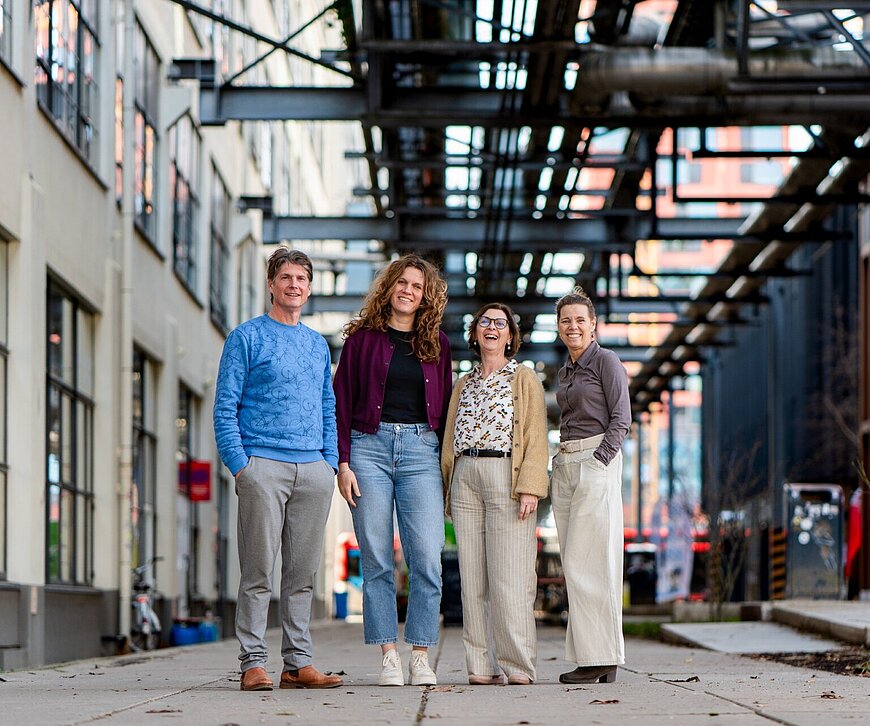
How do you help young people discover what they’re interested in, in a world where careers are changing at breakneck speed? According to four experts from the worlds of education and practice, it doesn’t start with a career aptitude test, but with experience. Let young people create things, solve problems and work together, and they will discover their talents naturally. Minette van den Bemd and Barbara Dresen, representing BiOND – the association for educational support staff such as counsellors and career advisors – discuss this with Mieke Zijlstra of Brainport Development and Hugo Vrijdag of the Ontdekfabriek. Through the interregional TATOE (Talent Workshop of the Future) project, they are working on new ways to bring career development closer to real-world practice.
It all begins in a small cinema auditorium at the Ontdekfabriek in Eindhoven. Young people sit in the dark watching a video. On the screen, a drone flies over a flooded area. Roads have disappeared beneath the water; emergency services can no longer reach the area. Yet people there still need to be supplied with water, food and emergency supplies. The solution: a cardboard box with a parachute that is dropped from the drone. But it’s not that simple. The box must open up, the contents must not be damaged, and the package must land safely. And it certainly mustn’t land on anyone’s head. In the video, you can see how people think through this challenge step by step, until they finally succeed and the relief supplies land safely on the ground.
After that, it’s up to the young people themselves. ‘We always say: we’re not doing a technical project,’ explains Hugo Vrijdag. ‘We’re going on an adventure. It starts with a story that touches the children. Then they’re free to explore for themselves how they would solve such a problem. And you immediately see that everyone contributes in their own way.’ That adventure takes place at the Ontdekfabriek, where young people build, test and experiment during school visits or children’s parties. ‘The great thing is that you see talent emerging very quickly there,’ he says. ‘One turns out to be a fantastic organiser, another comes up with creative solutions, and yet another dives straight into building. Every child discovers what gives them energy. And once a pupil realises what they’re good at, they never forget it.’

Discovering talent through hands-on experience
This approach fits perfectly with TATOE, an interregional partnership between organisations in the Netherlands and Flanders that focuses on young people aged 12 to 18. De Ontdekfabriek is one of the partners within TATOE, where this very combination of storytelling and hands-on experience takes centre stage. The experiences utilised at De Ontdekfabriek form an important part of how TATOE aims to help young people learn. According to Mieke Zijlstra of Brainport Development, this fits well with the region’s approach to talent development. ‘We believe it is important for children to be able to discover their talents as fully as possible. This also involves them coming into contact with engineering and technology. Not because everyone has to become an engineer, but because technology is everywhere these days.’
Within the project, teaching packages are therefore being developed that schools can use to help pupils discover their talents. Mieke: ‘Schools can use these to get started themselves. The idea is that pupils don’t just talk about their future, but actually do things. By building, testing and working together, they discover where their interests and skills lie.’
Career development starts with experience
For BiOND, this has a direct impact on day-to-day practice. Director Minette van den Bemd has seen how the field of career guidance has changed in recent years. ‘We used to talk about career guidance and counselling. Nowadays, we increasingly talk about career development. That difference is important. It’s not just about choosing a course of study or a profession, but about discovering how you develop yourself and what suits you.’ According to Minette, that process is starting earlier and earlier. ‘You could actually see LOB as the precursor to lifelong development. The sooner young people discover where their talents lie, the better they will be able to make choices later on.’
Barbara Dresen, an expert in career development and guidance at BiOND, also notes that the labour market demands this. ‘Professions are changing so rapidly that no one can predict exactly what a job will look like in fifteen years’ time,’ she says. ‘That is why the focus is shifting from choosing a single profession to developing skills. If you know what you are capable of and what you are good at, it is much easier to explore different directions.’
It happens outside the classroom
Yet, as Hugo observes, career guidance in many schools still relies mainly on textbooks and discussions. ‘Pupils often complete career tests or read about professions. But it’s precisely when you go out and experience things outside the classroom that something happens. Here you see children who think technology isn’t for them. Then they’re up there hammering away and I ask: who’s holding a hammer for the first time today? A large number then put their hands up.’ According to him, this confirms just how important it is for young people to gain a variety of experiences. ‘Children are naturally curious. Give them a challenge and they’ll start exploring. And along the way, they discover talents they didn’t even know they had.’
Teachers as the link
For Brainport, the key ultimately lies with the teachers. Mieke: ‘After all, they work with children every day. That’s why we’re looking at how we can support them. Often, they’re already doing a great deal. By highlighting that, you can further strengthen the learning process.’ It is precisely by acknowledging this, she believes, that LOB can continue to grow. ‘When a teacher sees a pupil working well with others, coming up with something creative or solving a problem, something happens. That experience then becomes part of that pupil’s development.’
Spreading ideas to schools
This is a key task for BiOND. The association is in direct contact with head teachers and careers advisors at schools throughout the Netherlands. ‘We can raise awareness of initiatives like this among our members,’ says Minette. ‘If head teachers know what’s going on, they can refer pupils to these initiatives or implement them at their own schools. We really see ourselves as a connector.’ The ultimate goal is for experiences such as those at the Ontdekfabriek to become part of a broader curriculum. ‘Ideally, LOB (career guidance) runs from the first year of secondary school right through to further education. And actually, it starts even earlier.’
TATOE is funded under the Interreg VI Flanders-Netherlands programme, the cooperation programme with financial support from the European Regional Development Fund.