New network prioritisation puts pressure on SMEs: ‘Together, we can organise space’
The new social prioritisation framework, as established by the Netherlands Authority for Consumers and Markets (ACM), will come into effect on 1 January 2026. This framework determines who gets priority on the electricity grid in the event of grid congestion. The impact on innovative SMEs is significant — but collective system innovation offers prospects, says Peter Engels of RAI Automotive Industry NL.
From now on, grid capacity will no longer be allocated based on connection type, but on social value. The framework distinguishes between three priority groups: congestion mitigators, safety and basic needs. The categories of safety and basic services have been expanded to include more social functions.
From 1 July 2026, small consumers, such as many SMEs and public charging points, will also be placed on the waiting list. They will no longer be automatically connected. The same applies to them as to large consumers: those who can demonstrate that they have social priority will be given priority.
Electrification under pressure
‘Many SME manufacturing companies are busy electrifying their production, logistics and vehicle fleets,’ says Engels. ‘If individual companies are no longer able to obtain additional capacity, this development will come under pressure.’ Long waiting times and investment uncertainty are a threat, especially in regions where grid congestion is already acute.
System change as an opportunity
Nevertheless, the new framework also offers direction. The highest priority is given to “congestion mitigators” – parties that actively contribute to relieving the grid.
‘The solution lies not only in grid reinforcement, but also in system innovation,’ says Engels. ‘By combining local generation, storage and smart energy management, companies can organise flexibility together. In doing so, they increase their future-proofing and help the grid.’
From 2027 onwards, grid operators will also reserve part of the grid capacity for unforeseen circumstances. The remaining capacity will then be allocated according to this new framework. This underlines the importance of acting now.
Charging Energy Hubs: collective organisation
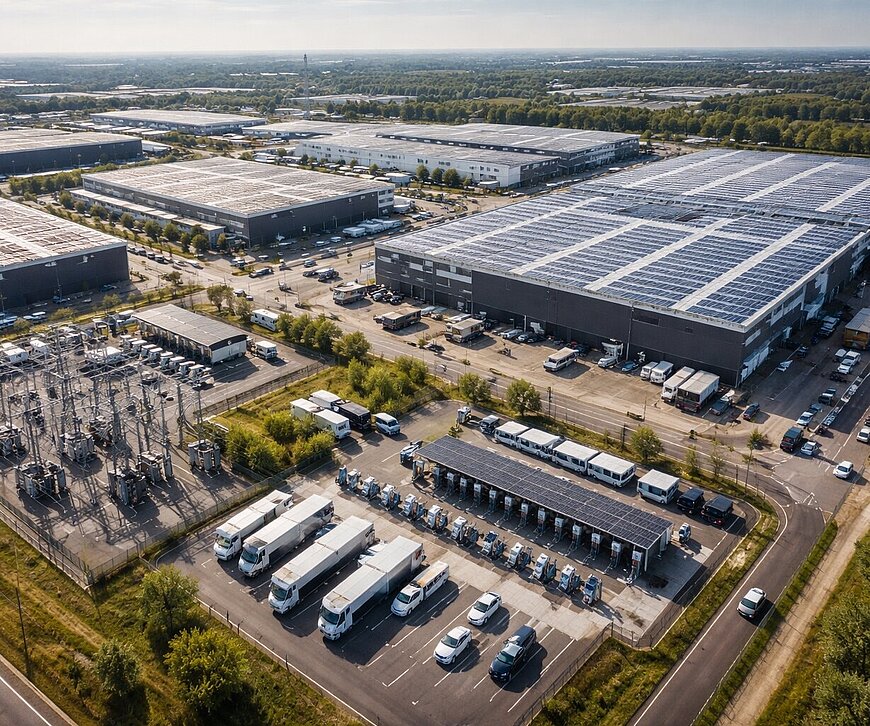
Within the Charging Energy Hubs innovation programme, RAI Automotive Industry NL and Brainport Development, together with partners from the business community, government and knowledge institutions, are developing collective energy systems on business parks. Not as quick fixes, but as future-oriented solutions.

System change as an opportunity
Nevertheless, the new framework also offers direction. The highest priority is given to “congestion mitigators” – parties that actively contribute to relieving the grid.
‘The solution lies not only in grid reinforcement, but also in system innovation,’ says Engels. ‘By combining local generation, storage and smart energy management, companies can organise flexibility together. In doing so, they increase their future-proofing and help the grid.’
From 2027 onwards, grid operators will also reserve part of the grid capacity for unforeseen circumstances. The remaining capacity will then be allocated according to this new framework. This underlines the importance of acting now.
Charging Energy Hubs: collective organisation
Within the Charging Energy Hubs innovation programme, RAI Automotive Industry NL and Brainport Development, together with partners from the business community, government and knowledge institutions, are developing collective energy systems on business parks. Not as quick implementation counters, but as future-oriented solutions.
‘Individually, you may be at the back of the queue. But as a collective, you can become part of the solution,’ says Engels.
Act now, think broader
RAI Automotive Industry NL calls on entrepreneurs to gain insight into their future electricity demand in good time and not to postpone applications. At the same time, the new reality calls for a broader, collective perspective. ‘The energy transition requires cooperation and systems thinking,’ says Engels. ‘Innovation programmes such as Charging Energy Hubs show how we can organise ourselves more intelligently on a structural basis. This is necessary to keep the Dutch manufacturing industry competitive and future-proof.’ Social prioritisation does not provide additional grid capacity. But it does offer a route to organise space collectively. And that starts today.