Data as the key to growth in Brainport Eindhoven
In Brainport Eindhoven, more than a thousand companies are now on a waiting list for a connection. This not only slows down growth, but also puts pressure on the sustainability of the region. Nevertheless, they have opted for cooperation rather than stagnation. With Data Safe House as a digital hub, the companies and network operator Enexis are building a shared data structure that will enable sustainability plans to be better interpreted.
Invisible brake on innovation
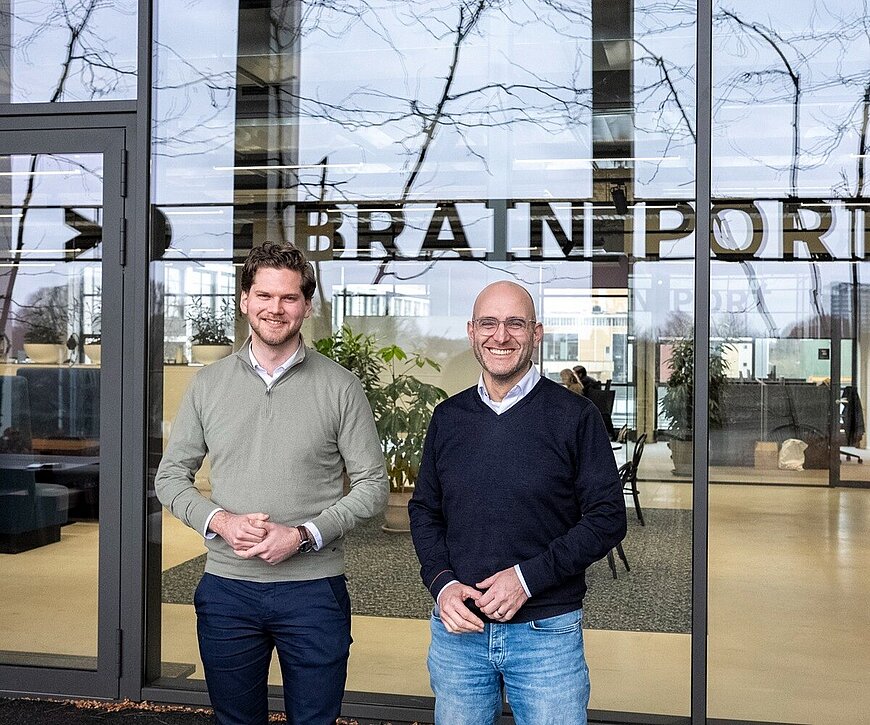
‘Our region has been growing faster than the rest of the Netherlands for a number of years now,’ says strategic advisor Didier Barrois of Brainport Development. ‘But things are at a standstill at all distribution stations in the region. Companies are on a waiting list for electricity. And in the meantime, they want to become more sustainable, electrify and expand.’
Housing, mobility and infrastructure also require more power. The result: an invisible brake on innovation. Companies reported individually to network operators, municipalities, the Eindhoven Metropolitan Region and Brainport Development. ‘We saw fragmentation,’ says Didier. ‘That's why we started a helpdesk together with Enexis. To bundle individual cases and take a smarter look: where is there room, where can we smooth out peaks, where can we cluster?’
This also gave rise to the idea of working with Energy Hubs: collective agreements in business parks to make better use of the existing grid. ‘We drew up group contracts and in some areas, entrepreneurs are now working together to prevent peak loads. For example, by not starting up all cleanrooms at the same time. This created space within the existing grid.’

From waiting to knowing
This collaboration developed into a broader approach, with Data Safe House serving as a central hub for data exchange. ‘We observed how Data Safe House was used to securely and centrally collect data in the Rotterdam port area,’ Didier explains. ‘At first, we thought: that's for clusters with large industrial players, but not for us. But in fact, we encountered the same problems: network operators need data for realistic investment plans. And so, through the Ministry of Climate and Green Growth, we got back in touch with Data Safe House. We simply cannot sit around and wait.’
What does Data Safe House do differently here?
Lasse Westerhof from Data Safe House explains: “In Brainport, we had to slightly adjust the approach we use for concentrated clusters in the Netherlands. We don't have 25 large companies in one port area here, but have focused on 200 large and small companies spread across 21 municipalities. The key? The role of Enexis' relationship managers. They have warm contacts with the companies and introduced what Data Safe House does and why it helps. That had a huge flywheel effect."
The digital platform itself has been adapted for smaller companies: simpler, more intuitive, and with a focus on electricity. ‘We have moved all unnecessary fields to the background so that companies that only work with electricity and gas can enter their data quickly and independently,’ says Lasse. ‘Hydrogen and other energy modalities can also be entered, but are optional.’
‘It's important that companies can share data as easily and securely as possible.’
Lasse Westerhof, project coordinator at Data Safe House
Why companies participate
Many companies have been on a waiting list for years, but were still sceptical. Didier heard: ‘Why should we provide data for the next 15 years when we're not even being helped now?’ But the tide turned. ‘We explained that if you share data, network operators can make better plans and your company can influence the future energy infrastructure. And if you don't share your figures, you also slow down the development of your neighbours. Companies understand this regional interest very well. The network issue affects the entire chain.’
‘Companies now understand that sharing data goes beyond their own interests and affects the entire region.’ share data as easily and securely as possible."
Didier Barrois, Brainport Development
Lasse adds: ‘The security and confidentiality of the platform are a huge help. If municipalities, research agencies or Brainport Development itself need data, they don't have to approach 200 companies separately. Data Safe House acts as the central hub. And they only get access to certain data with the companies' permission. That saves everyone time and administrative hassle.’

Realism
The initial insights are promising. ‘We are seeing ambitious but realistic forecasts,’ says Lasse. ‘And we validate the data together with the DSH manager. This means that network operators can really use it. There is no longer any overestimation or incompleteness.’
Didier: ‘Together with Enexis, we are looking at where companies can save money, generate and store their own energy, or share energy with others. Some parties indicate that they have residual heat available. Others want to generate energy at their own location. This means we can already do more with the existing grid.’
Lasse: ‘Another insight is that gas consumption will decline in the coming years, but that this will not automatically lead to an equal increase in electricity consumption. This nuance helps the grid operator with its planning.’
Part of standard process
The joint network operators in the Netherlands have now officially designated Data Safe House as the central platform for retrieving and sharing data on sustainability plans. Companies update their data annually; network operators use this information directly for network planning and investment decisions. This has made data exchange an integral part of existing processes such as DIVIT (the former Cluster Energy Strategy).
‘We are past the persuasion phase,’ says Lasse. ‘Data Safe House is now part of the normal working method. The network operator requests an update, the company provides it, we validate it and ensure that the data is usable. This creates a shared and realistic picture of the future. That is exactly what is needed to enable growth and sustainability, such as here in Brainport Eindhoven.’