The real strength lies in regional cooperation
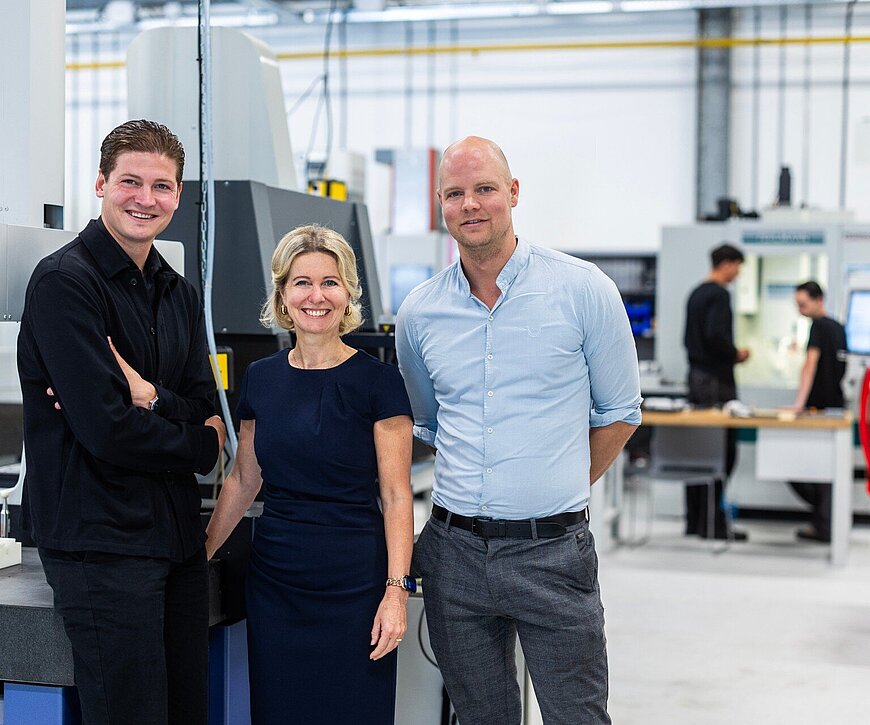
At the Techniek Centrum Brainport (TCB) workshop in Deurne, work is underway to tackle one of the Brainport region’s biggest challenges: finding enough skilled workers for the manufacturing industry. Whilst companies are ready to welcome new talent, there is a large group of people who are currently out of work or unsure of which direction to take. That is why the education sector, employers and labour market partners are joining forces in the Reskilling Metaal project. The aim is as simple as it is ambitious: to train talented jobseekers and career changers without a technical background to become skilled workers ready to start a career in metalworking, with a particular focus on the specialism of machining.
For many participants, the world of engineering is unfamiliar territory. Some have worked in a different sector for years, whilst others are jobseekers looking for a foothold and a training programme that enables them to work towards a specific role. This is exactly what the TCB offers, where you can develop your skills in machining at all sorts of levels.
First the connection, then the technical skills
But before anyone can enrol in Deurne, the team at Peijnenburg Re-integration plays a key role. During information sessions and personal interviews, they assess motivation, how someone lives their life and their future prospects. Technical experience is not important at all. Maarten Peijnenburg, reintegration coach: ‘We want to know who someone is, what drives them and whether they’re genuinely willing to take a new step. It’s precisely that motivation that often determines whether someone can succeed in a programme like this.’
Intensive support
Unlike many reskilling programmes, the organisation remains involved throughout the entire process. Maarten and his team help participants with employability skills and tackling job applications, but are equally supportive with personal issues that may affect their development.
Following a successful intake, participants start work at the TCB, the training centre where manager Ron Gommans is responsible for day-to-day operations. Here, technical specialists are trained in the field of machining in close collaboration with local businesses. The training programme is delivered in collaboration with Ter AA, which ensures that practical experience and education are well aligned. On behalf of Ter AA, Friso van den Berg maintains contact with employers in the region. ‘Many people initially think that engineering is complicated or inaccessible,’ says Friso. ‘We build it up step by step. People learn to read technical drawings, get to know the machines and discover the trade. As a result, their confidence grows quickly and participants realise that engineering is much more accessible than they initially thought.’

A give-and-take arrangement
The programme is structured as follows: for the first few weeks, participants learn the trade at the TCB, and from week five onwards they start working in a company. From that point on, they combine two days of lessons at school with three days of work on the job. It is precisely during this period that the support provided by Peijnenburg Re-integratie really comes to the fore. ‘If someone needs to get back into a routine after a long break, or is facing challenges at home, you want to be there for them early on,’ he says. ‘We’re present at the school and hold regular one-to-one meetings. We also visit participants on the shop floor and simply stand right next to the machine. ‘What are you doing? How are you finding it here?’ It’s precisely during those first few weeks that someone needs to settle in. If you’re keeping a close eye on things, you know straight away what’s going on and can react quickly.’ Thanks to this intensive support, participants get off to a flying start, which also makes the programme attractive to employers.
That does, however, require something in return, as the partnership works both ways. A company wishing to have retrainees trained also gives something back to the school, for example by delivering practical lessons at the training centre itself. According to Friso, it is precisely this interaction that is important. Companies not only make workstations available, but also share their knowledge and experience with new participants. ‘Experienced skilled workers are in short supply. That is why we are working together to see how we can guide motivated career changers towards roles where there is high demand. This can only succeed if employers are prepared to invest in that development.’
The power of working together
According to Natasja Muskens, project leader for the metal technology pre-employment programme, it is precisely this collaborative approach that makes the difference. From the Zuidoost-Brabant Employment Centre, she brings together employers, educational institutions and labour market partners within the Brainport Academy.
‘What makes this programme special is that everyone contributes based on their own expertise,’ she says. ‘Educational institutions, employers, support services, labour market partners; we all do it together. This collaboration is made possible by financial contributions from sector organisations and R&D funds. Its success stems from organisations being willing to look beyond their own roles.’
This was also evident when the labour market temporarily took a turn for the worse and vacancies came under pressure. Instead of giving up, the parties involved continued to look for opportunities. The result of the programme: around eighty per cent of the candidates found a role within the technical sector. Of the remaining twenty per cent, some made a conscious choice to pursue a different path, for example by starting a higher professional education programme or a career outside the technical sector. For Natasja, this confirms what she has been observing for some time: ‘There is far too much untapped talent sitting on the sidelines. Every person who feels happy again in the labour market thanks to this opportunity counts.’
The pilot has proven that it works, even though the group numbers are slightly lower than hoped for. That is why work is now underway on new programmes and further scaling up within the Brainport region. Not only to guide more people towards the metal sector, but also to further strengthen collaboration. ‘The real strength lies in regional collaboration; it’s simply worth its weight in gold,’ concludes Natasja. ‘People and organisations are willing to look beyond their own interests. It is precisely this that enables us to develop talent, help employers and embed this approach sustainably.’