Smart camera eases pressure on nursing staff
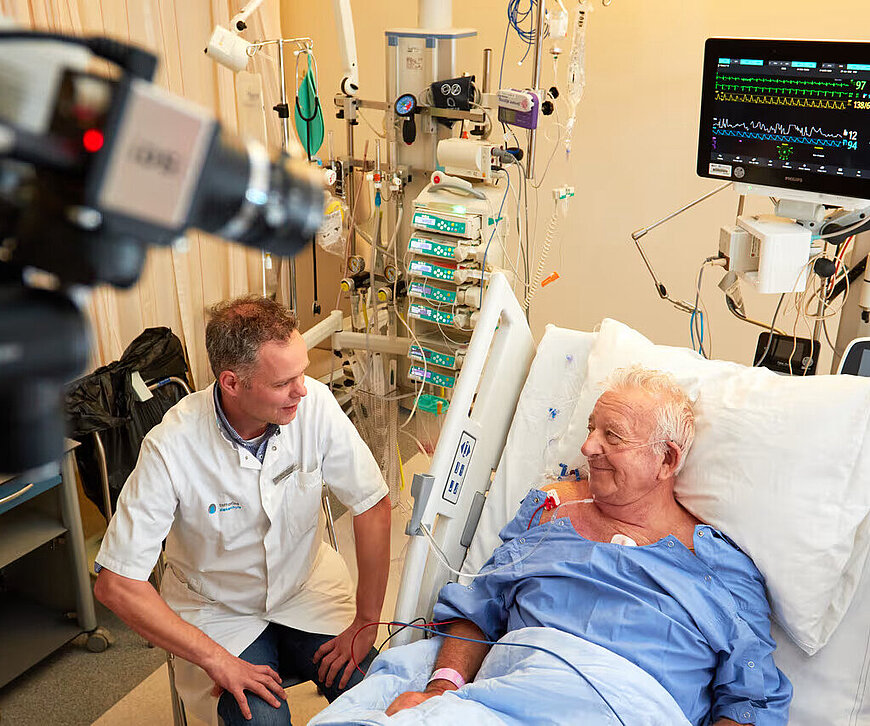

The Catharina Hospital in Eindhoven, Eindhoven University of Technology (TU/e) and Philips are developing a camera that monitors patients' vital signs.
On Monday 2 March, IO+ was invited to the Catharina Hospital for a presentation on the Advance ForSee project. The project is a collaboration between the Catharina Hospital, Eindhoven University of Technology (TU/e) and Philips. They have developed cameras with AI to detect changes in a patient's vital signs after surgery. Less administration means that nursing staff can spend more time with patients. ‘This saves an average of 10 minutes per patient,’ says cardiologist and professor Lukas Dekker.
For the time being, the camera is only intended to monitor heart patients. After open-heart surgery, this is the group that is most susceptible to cardiac arrhythmia and internal bleeding. Ultimately, according to the researchers, the intention is to also use the camera for patients who have undergone vascular surgery, for example. ‘The model must be adapted for each patient group,’ according to anaesthesiologist and professor Arthur Bouwman.
Early detection of complications
During the recovery phase after heart surgery, approximately 10% of patients in the nursing ward experience complications. ‘In addition, 40% of unexpected deaths in hospital occur in a nursing ward,’ says Dekker.
In intensive care, patients' vital signs are continuously monitored with advanced equipment, the “gold standard”, according to Dekker. In the nursing ward, checks only take place every 6 to 10 hours. According to Dekker, what happens between these check-ups is crucial for identifying complications at an early stage.
Due to budget cuts and a shortage of beds, doctors, nurses and other hospital staff are under considerable pressure. ‘We have to do more and more with less and less,’ says Dekker. This makes continuous monitoring difficult, which means that complications are sometimes detected too late. Video monitoring offers an innovative and cost-effective solution here.
After open-heart surgery, patients remain in hospital for at least five days.

How does the camera work?
Three cameras are focused on the patient's head and chest. One camera is for daytime use and two (infrared and black and white) are for night-time use, explains Rik van Esch, PhD student in electrical engineering at TU/e.
Images are recorded and analysed by the software 24/7. No human intervention is required, according to Van Esch. Machine learning enables the software to alert doctors and nurses when there are notable changes in health. The addition of AI also allows predictions to be made about possible complications based on the vital signs detected.
Requirements of patients and nursing staff
‘Strangely enough, the nursing staff were more reluctant to use it than the patients,’ says Dekker. For the nursing staff, it is important that it takes away the burden of registration and does not add to it. Because the nursing staff no longer have to take measurements and enter the data themselves, they can spend that time on the patient instead.
Dekker indicates that the most important condition for patients is that they can have privacy when it suits them. Think of a moment of care or a family visit. A mechanism has been devised for this that can place a cover over the cameras by pulling a cord. ‘Turning the cameras on and off was also an option, but shutting down and restarting the cameras and the system took too long,’ says Bouwman. With the cover, the cameras can continue to run.
Once the equipment is in full use, measurements may be stored for up to six months after the patient has been discharged from hospital, says Dekker.
How far along is the project?
The project started in 2021 and is currently still in the development phase, says Bouwman. So far, doctors and researchers have tested Advance ForSee on ‘hundreds of patients,’ according to Dekker. Scientific research and publication in professional journals are also required before various parties can give their approval, explains Dekker. This includes authorities that oversee privacy, ethics and accountability.
Like other AI and machine learning models, the software must learn to deal with a variety of situations: for example, skin measurements in someone with facial hair or scars, or in different sleeping positions. It must also learn to deal with different skin colours.
Your heart rate changes the colour of your face, which Bouwman calls microblushing. The cameras therefore measure the patient's heart rate. The camera is most effective when the facial colour is light and when there is sufficient light in the room. ‘In people with darker skin, it is still difficult to see when the facial colour changes through the cameras,’ says Dekker.