From a robotics competition to a talent pool for the Brainport region
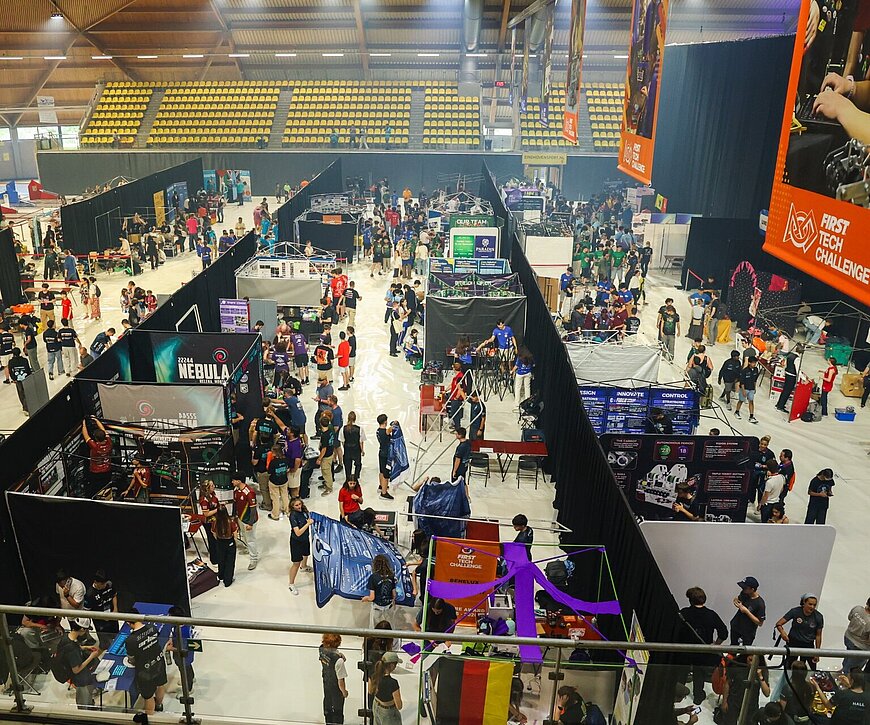

For the second year running, more than a thousand young people from 33 countries travelled to Eindhoven for the final of the FIRST Tech Challenge (FTC) European Premier Event. They had spent months building their robots and were competing for the coveted first prize. But anyone looking closely could see that it was about much more than just a competition.
In the world of FIRST robotics, there are three competition levels: the FIRST LEGO® League (FLL) for primary schools, the FIRST Tech Challenge (FTC) for secondary school pupils, and the heavyweight FIRST Robotics Competition (FRC) for school pupils, university students and young professionals. In Eindhoven, the teams competed in the FTC.
A thousand tech enthusiasts from all over the world
It was sweltering outside, but inside the Indoor Sportcentrum Eindhoven, the temperature was just as high. There, balls flew through the air, the stands roared with cheers and more than a hundred self-built robots whizzed across the playing arenas. Over a thousand young tech enthusiasts from 33 countries – from Brazil to Lithuania and from Japan to the United States – gathered for the moment they had been looking forward to for months: the FTC final. Teams of secondary school pupils from all over the world competed against each other here with their self-built robots.

And not just against each other, but also alongside each other. Teams formed constantly shifting alliances, so your ally in the morning could just as easily be your opponent by the afternoon. That spirit of collaboration – known in the FIRST world as ‘Coopertition’ – is ingrained in the game. The entire tournament was streamed live, complete with officials and commentators. Organiser Ron Visser, involved through the STEAMup foundation, got little sleep in the run-up to the event, but enjoyed it to the full. ‘It’s just brilliant to have all those teams together and give each other a glimpse behind the scenes. That spirit of mutual cooperation is really strong.’
More than just a spectacle
Behind the festivities lies a greater ambition: to get young people excited about technology. And according to Ron, that starts long before this stage. ‘The strength lies in the continuous learning pathway, from the LEGO® League at primary school to the Tech Challenge and then the Robotics Competition.’ That is why they are now looking at how more schools in the region can get involved. ‘In the region, around forty of the nearly two hundred and forty schools took part in the FLL and FTC qualifying rounds. We will soon be matching students with schools, who will be paid to coach for a few hours a week.’ In this way, schools receive support to take their first steps.
Paul Hulshoff, education project manager at Brainport Development, sees how several initiatives are coming together in this regard. ‘You have the hybrid teaching programme, Techkwadraat and the link via the Beethoven project. Together, these ensure that the barrier to entry for schools is lowered.’ After all, participation must remain accessible to everyone. ‘You can take part at all levels and from all backgrounds. Some people love building or programming, whilst others thrive on the team dynamics. Everyone can contribute their own strengths, but ultimately it’s about creating something together.’ In the sweltering Indoor Sportcentrum Eindhoven, Paul was in awe: ‘What’s really wonderful is the enthusiasm of the young people. You see thirteen- or fourteen-year-olds standing here speaking English as if they’ve already completed a bachelor’s degree. Without even realising it, they’re picking up so many skills at a young age: communicating, presenting, collaborating and connecting with other teams.’
You have to experience technology
That early introduction to technology is precisely what the Beethoven project – the large-scale investment programme for the Brainport region – focuses on. Simone Jilderda, Beethoven programme manager on behalf of Summa, emphasises that young people must, above all, experience technology. ‘We know from research that it is crucial for children to be exposed to technology between the ages of five and twelve. If you don’t do that, at some point they will only be aware of a limited number of careers. You have to show young people what technology is and, above all, let them experience how much fun it can be.’ According to Simone, an event like the FTC final helps to break down preconceptions. ‘You still often hear that technology is dirty, difficult or only for boys,’ she says. ‘But when you walk around here, you see something different. The split between boys and girls is almost equal. You see different talents coming together. Everyone has a role in the team.’

Sowing the seeds for the future
Ron sees the impact of promoting technology in the choices participants make later on. ‘American research shows that 83 per cent of participants opt for a STEM (Science, Technology, Engineering, Mathematics) degree,’ he explains. Within his own Dutch team, that percentage is even higher: of the pupils who have been part of it over the past thirteen years, over 92 per cent chose to pursue further technical education.
For the Brainport region, FTC is therefore not just about building robots or winning competitions, but about developing talent and helping young people discover the opportunities that technology offers. This impact is not limited to the workplace. International talent is also getting to know the region and increasingly sees Eindhoven as a place to further their development. Ron: ‘Following last year’s event, twelve participants chose to study in Eindhoven, in fields such as Mechanical Engineering, Electrical Engineering and Computer Science.’
For Ron, that is precisely where the strength of FIRST lies. He therefore looks beyond the final in Eindhoven: ‘My life’s mission is for every primary school in our region to have an FLL team and every secondary school to have an FTC team. We’re working hard on that. You mustn’t just plant the seed; you must also give it sunlight, water and nourishment so that it can grow.’