As far as the nets reach: Brabantfish makes the most of every kilowatt and looks beyond its own premises

At fish farm Brabantfish in Son, sustainable fish farming begins with water that is constantly in motion. Five million litres of water are pumped round, heated, filtered and monitored day and night. It is within this closed system that the family-run Claresse Visverwerking B.V. breeds its own hybrid of two species of catfish, developed to produce a high-quality fillet and a high meat yield. Everything takes place in Son; from birth and growth to processing. As a result, a fish that is still swimming around in the morning is already on its way to the customer, packaged, that very afternoon. Because farming and processing take place in a single location, transport movements are kept to a minimum and the company maintains control over quality.
For Mark Foolen, this short supply chain is essential. Brabantfish competes on quality and reliability. That is precisely why the family business wants to keep as much as possible under its own control: from farming to processing and, increasingly, the final packaging too.
Foolen runs the business together with his two brothers. Geert focuses on farming, Frank on processing, sales and staff, and Mark on technology, maintenance and new construction. This division of responsibilities was a conscious choice. “So that family ties remain strong,” he explains. The foundations were laid in 1996, when his parents switched from pig farming to fish farming. First with eel, later with tilapia. Eel made the business dependent on catches from the sea, whilst the tilapia market came under pressure from cheap imports. The quest for greater control over quality led the family to Claresse.
Everything has value
Brabantfish’s sustainable approach starts with a simple idea: do not waste anything that still has value. This applies to water, heat, raw materials and the fish itself. The farming process is closed-loop and antibiotic-free. At its core, it revolves around water, fish and feed.
Brabantfish also seeks to maximise the value of its waste streams. Collagen is extracted from the skin, trimmings go to processors, and for bones and heads, the company explores uses such as soup or stock. Extracting more value from waste streams sounds logical, but again requires energy: for freezing, drying or further processing. It is precisely this energy that is in short supply. Thus, even the question of what to do with waste streams becomes part of the energy puzzle.
Craftsmanship without grandstanding
Anyone listening to Foolen speak will notice that he doesn’t readily put himself on a pedestal. According to him, Brabantfish is “actually quite a down-to-earth business”: practical, having grown from the ground up, and reluctant to promote itself. That modesty perhaps does the company an injustice. Behind the down-to-earth tone lies a company that is further ahead than you might think at first glance: in local food production, the use of waste heat, circularity and the smart use of energy.
Foolen doesn’t keep his expertise to himself. Brabantfish shares its knowledge with other fish farms, both in the Netherlands and abroad. “Even though we’re competitors, it’s important that everyone brings a good product to market,” he says. After all, a bad experience with one product can just as easily damage confidence in similar fish.
That attitude extends beyond the Netherlands. In Africa, a biologist from Brabant Fish is helping to set up fish farms from the ground up. Foolen refers to it, almost in passing, as a moral obligation. If you have knowledge, you should share it.

Every degree of heat counts
Energy is an integral part of day-to-day operations. In the hatchery, the water must be kept at a constant temperature of around twenty-seven degrees, whilst pumps run day and night. Cooling and freezing systems are also essential for ensuring freshness and quality. Downtime is not an option when dealing with live fish.
That is why, in recent years, the company has reviewed virtually every energy flow. The water is heated using heat pumps that utilise waste heat. Heat from cold stores and freezer rooms is recovered and reused in the fish farm. A district heating network runs beneath the premises. Only in winter is gas still required, due to the limited power capacity at the connection point. “If we have a roof, we need to put solar panels on it. If heat is released, it must be channelled into the hatchery,” he says, summarising his approach. As a mechanical engineer, Foolen works out many technical aspects himself. Energy is precious, wasting heat is a shame, and a smarter system makes the business more resilient.
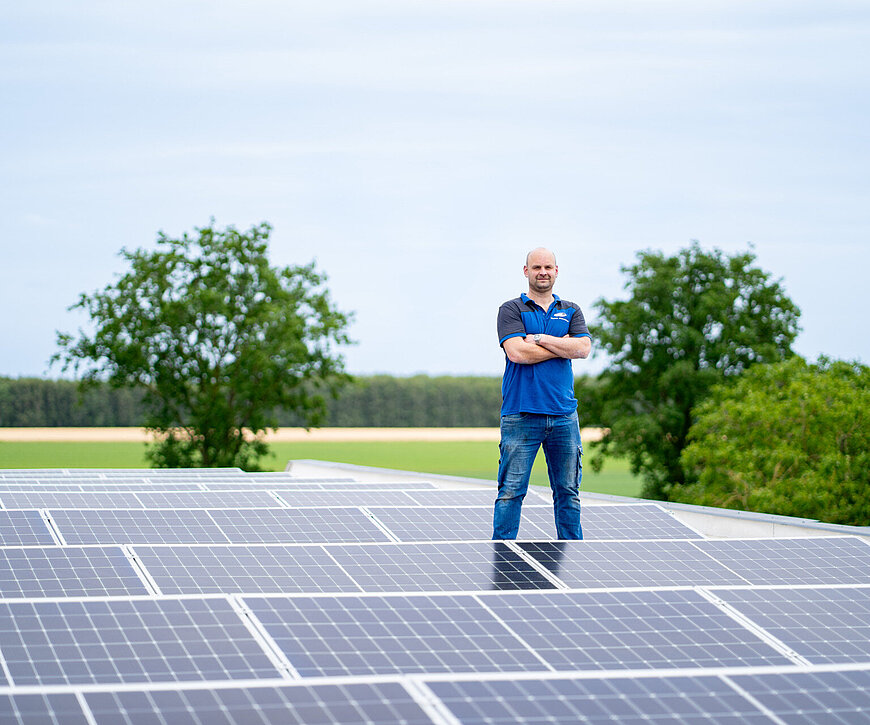
That approach makes a difference. On sunny days, the business can cover its daytime consumption entirely through the solar panels. Thanks to these panels, the business generates half of the energy it needs itself. Yet that does not solve the energy puzzle. The sun doesn’t always shine, winter demands more power, and the processes in the nursery can only be controlled to a limited extent. “It’s living stuff,” says Foolen; a cultivation system requires continuity.
Moving forward without waiting
There is also a downside to this forward-thinking approach. Brabantfish ran out of funding on several occasions. Heat pumps were installed just before the schemes became available, and the district heating network was ineligible for funding because it was part of a new-build project. Nevertheless, the company did not wait. “You do it because you want to,” he says. “And because you think it’s important to show that you’re doing things properly. But yes, it is a shame when the funding only comes through afterwards.”
Managing peaks
The next step centres on the timing of energy use. Brabantfish has recently installed batteries and is working on rolling out an energy management system. This will enable the company to better align its installations with solar generation, electricity prices and peak times.
Some processes offer flexibility. When there’s plenty of sunshine, a freezing system can run at full capacity. At times when electricity is expensive or demand is high, that same system can be temporarily scaled back, provided product quality remains assured. The batteries help to absorb peaks and remain within the agreed transmission capacity. The battery has a capacity of one megawatt. The system has only been operational for two months, so the first winter will determine whether the batteries provide sufficient capacity.
This fine-tuning is necessary because Brabantfish is reaching the limits of its power connection. The company’s plans require more power capacity than is currently available. Previously, this even meant that work had to be temporarily outsourced. For Foolen, this is not in keeping with the nature of the product. He wants to keep the supply chain short and be able to monitor quality fully right up to the moment of dispatch.
Growth requires power capacity
A new hall on the site illustrates Brabantfish’s vision. The ambition lies not in producing larger quantities of fish, but in adding more value to the product. Whilst much of the fish is currently still sent to buyers in large boxes, the company aims to move further towards consumer packaging, seasoned products, pre-cooked fish or complete meal components.
This step, too, has been designed to generate more energy than it consumes. The hall, which houses cold storage, frozen storage and processing areas, is energy-positive. The solar panels on the roof fully power the refrigeration system, and all residual heat is utilised in the fish farm, meaning that more energy is generated by the building than is consumed.
Nevertheless, further processing again requires capacity. Heating, cooling, freezing, packaging: every step must fit within the available power capacity. The existing processes cannot simply be scaled back, and new activities must be able to operate reliably all year round, even in winter.
Foolen puts it matter-of-factly: “There’s also a winter period when you want to deliver. You can’t say no then.” Brabantfish is on the waiting list for extra capacity, but it is unclear when that will become available. Grid congestion thus becomes a very real issue. It determines not only the energy bill, but also the pace at which a company can innovate, become more sustainable and add value.

Working smarter together with power capacity
Brabantfish is therefore looking beyond its own premises. Together with local businesses, Foolen is investigating whether their energy profiles can complement one another. If one company requires a lot of power at times when another is using less, there may be scope to utilise the available capacity more intelligently. It’s still in its early stages, he emphasises, but the idea appeals to him: “I think everyone can benefit from this.”
This idea fits in with the way Brabantfish has been operating for some time: identifying where there is scope, and making the best possible use of it. Within its own premises, this has been done with heat, water and waste streams. Now, the same logic is being applied to collaboration in the immediate vicinity. In the longer term, integration into the Sonniuswijk energy landscape may also offer added value.
Building on what works
For Foolen, success does not automatically mean doubling the business or growing as quickly as possible. “What is success?” he wonders aloud. “I think it’s a success that there are three of us brothers and we can support our families with this business. Or, better still: the families of all the staff who work for us as well.” Brabantfish employs around twenty-five people. His parents are still involved on a daily basis.
For Foolen, Brabantfish’s role in the energy transition lies primarily in what the company does on a day-to-day basis. “We’re not the type to make a big fuss,” he says on the subject. The practice speaks for itself: quality comes first and every step in the process is being continually refined. Heat is recovered, electricity is stored, waste streams are put to better use and systems are being controlled in increasingly smart ways.
For Foolen, the next step is primarily a practical one: adding more value to the fish, maintaining control over quality, whilst staying within the limits of the available electricity capacity. Brabantfish wants to move forward, but only in a way that suits the company: carefully, pragmatically, and as far as the grid will allow.