Reimagining Human Senses: HART’s Vision for Wearable Augmentation
At HART we believe that technology can do more than solve problems, it can expand what it means to be human. We’re exploring how non-invasive, wearable devices can redefine boundaries of human experience.

Historically, human augmentation has been closely tied to medical interventions or invasive enhancements. Today, however, emerging technologies such as wearable haptics offer new, accessible, and customizable ways to expand sensory capabilities.
The mission behind this research is twofold. First, to foster broader public understanding and conversation about human augmentation - its possibilities, ethical implications, and societal impact. Second, to develop a scalable platform that showcases practical applications of sensory augmentation and empowers others to contribute. Envision a future where users can download new senses for their devices as easily as they install apps today.
By advancing the science of haptic communication, this work aims to unlock new dimensions of perception, enabling richer, more inclusive, and more intuitive interactions between humans and the world around them.

Feeling Expressions: Touch-Based Communication Through Haptics
At the heart of our research is the development of a wearable haptic sleeve that lets you feel facial expressions on your forearm. It is embedded with a series of vibration motors that covert facial cues, such as a smile or a raise eyebrow, into unique tactile patterns. This offers a novel form of communication, particularly useful in situations where visual channels are limited or unavailable.

This approach opens the door to a broad range of applications aimed at augmenting human perception and enhancing accessibility. The flexibility of haptic communication allows for creative integrations with artificial intelligence, advanced electronic systems, and knowledge of the human nervous system to build new channels of interaction between people and their environments.

Listening to the Brain: Responsive Tech Through EEG
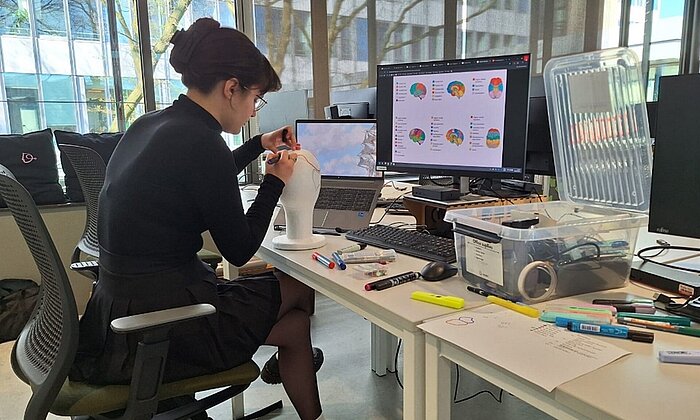
HART is also exploring the integration of electroencephalogram (EEG) technology to capture real-time brain activity and emotional states. Our goal is to develop a brain computer interface (BCI), that can provide responsive feedback based on neural activity. A key use case is supporting caregivers of patients with limited communicative abilities, helping them better understand the emotional or cognitive states of those they care for.
Follow the team!
Read all the latest updates from the TU/e HART team here!