North Brabant’s first GTO marks a new step in tackling grid congestion
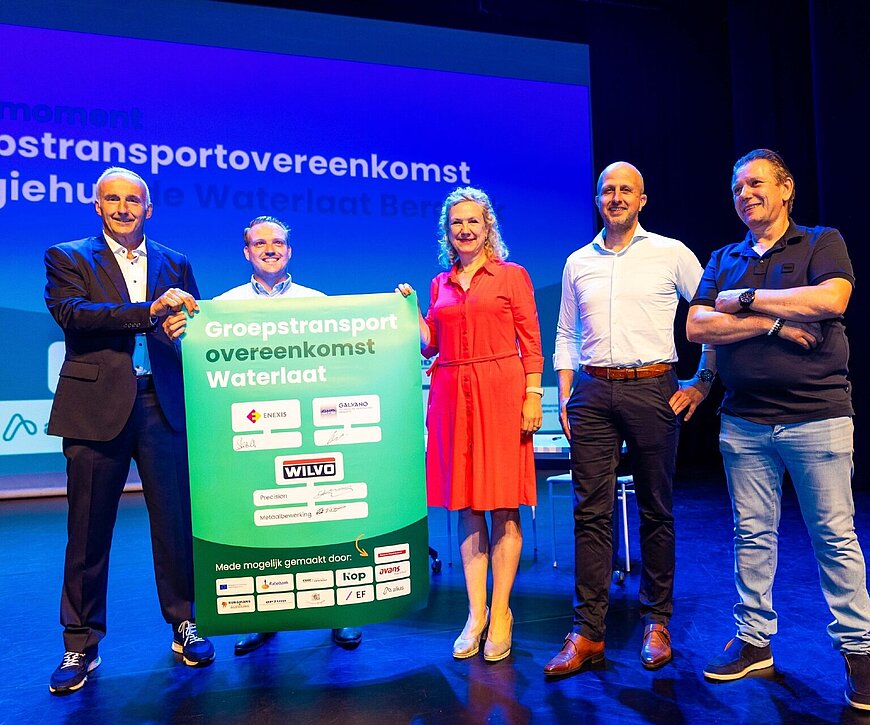
North Brabant’s first Group Transmission Agreement (GTO) was signed at the De Waterlaat business park in Bergeijk. This marks an important milestone for the energy hub in tackling grid congestion. Following years of research, measurements and intensive collaboration between businesses, research institutions, the government and the grid operator, the project is now entering the implementation phase.
Whilst grid congestion poses an obstacle for many businesses, the businesses at De Waterlaat chose to ask a different question: what is actually possible? This shared mindset has led to an innovative solution that makes smarter use of available grid capacity and creates scope for further growth and sustainability.
From collaboration to implementation
Under the Group Transport Agreement, the participating businesses and the network operator Enexis have agreed to organise energy consumption and generation jointly. By better aligning supply and demand, the available capacity on the electricity grid can be utilised more efficiently.
The signing took place under the auspices of the Kempisch Ondernemers Platform (KOP). Representatives from the Province of North Brabant, the municipality of Bergeijk, Enexis and the business community were among those present to underline the importance of this collaboration.
A pioneer for other energy hubs
The energy hub at De Waterlaat is now regarded as one of the pioneers in the Netherlands. The agreement was drawn up using the national GTO model developed by Invest-NL. This has laid a legal and practical foundation on which future energy hubs can build.
The knowledge and experience gained during the project are now also being shared with other energy hubs in North Brabant and beyond. The signing of a second Group Transmission Agreement at De Waterlaat is expected to take place in September.
Important for the Brainport region
For a region such as Brainport, where demand for electricity is growing rapidly due to economic development and the energy transition, initiatives of this kind are of great value. They demonstrate that collaboration between businesses, the government, knowledge institutions and the grid operator can contribute to concrete solutions for grid congestion.
The development at De Waterlaat shows that innovation is not just about new technology, but also about new ways of working together. It is precisely this combination that is essential to keeping the Brainport region accessible, sustainable and economically strong.
Read more
Read the full press release from the Kempisch Ondernemers Platform about North Brabant’s first Group Transport Agreement.
Read more