‘Sometimes you have to invest unequally for a while to ensure equal opportunities’
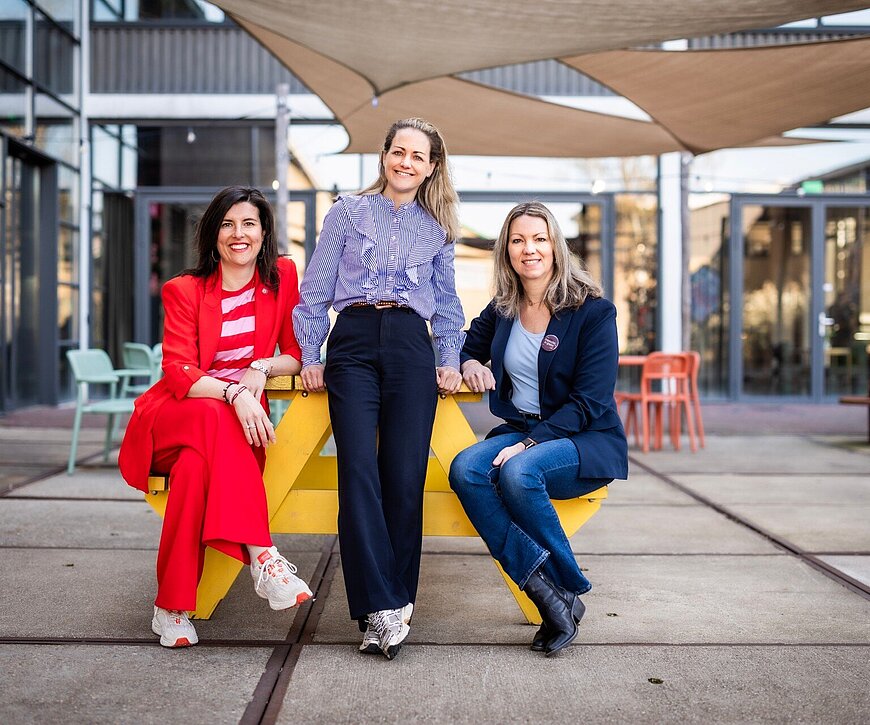

Close your eyes and think of a leader. What do you see? Lotte Geertsen, co-founder and board member of Future by Diversity, has a pretty good idea of what that picture looks like: most people picture a white man in his forties or fifties, wearing a sharp blue suit. Why would it be a good thing if that image changed? More diverse, more inclusive teams produce more and better innovations. Together with Astrid van Deelen (manager of the education and labour market team at Brainport Development) and Hilde de Vocht (founder of Fe+male Tech Heroes), she talks about her mission for the Brainport region. ‘You should be able to become whoever you want to be. It helps if you see diverse role models around you, in all colours, flavours and shapes.’
Hilde has been working at the High Tech Campus since 2008. She saw first-hand how companies were grappling with the issue of how to attract diverse talent and then retain it. There were small groups of women active on the campus, spread across various companies and buildings. But they hardly ever found each other. That is why Hilde, together with Ingelou Stol, launched Fe+male Tech Heroes in 2019. Even at their very first event, the venue was packed to the rafters. The network now consists of around 5,000 members and thirty corporate partners, and organises several events a year, including a conference, meet-ups and an awards show.
Scientific evidence
Lotte worked on that same campus for many years as director of innovation. She now works as an innovation entrepreneur on societal challenges and constantly sees how crucial different perspectives are, from idea to product. ‘It has been scientifically proven that more perspectives contribute to better solutions. In short: it makes innovation more successful,’ she says. Together with three other entrepreneurial women from the region, she launched Future by Diversity, with a growing community of over 300 women, including more than fifty mentees and over seventy mentors. This year, a mentoring programme was launched in which 25 women with ambitions for growth are paired with 25 female role models working in engineering, the manufacturing industry and IT. Over a six-month period, they meet at least five times, and joint company visits and events are also organised.
Astrid is manager of the education and labour market team at Brainport Development. She works daily on scaling up the region: it is expected that 50,000 additional engineers and IT professionals will be needed in the Brainport region in the coming years to meet employer demand. ‘To get the most out of all that talent, diversity is the key to success. The more different perspectives you bring together, the more ideas you get, and the more disruptive the outcome,’ says Astrid. ‘Diverse teams break through tunnel vision, improve error detection and lead to more robust decisions with greater innovation, better decision-making and stronger governance, with a demonstrable correlation to higher performance.’ But according to her, those benefits don’t come automatically: diverse teams are harder to manage and only deliver real results if you fundamentally redesign the system, from recruitment to decision-making. ‘We need to do that together.’

Beyond men and women
In some countries, this diversity is already somewhat more visible. ‘Take countries in Eastern and Northern Europe, such as Estonia, Poland, Bulgaria and Denmark. There, far more women work in engineering. These are examples for us,’ says Hilde. Lotte illustrates why this is so important with an example from the field of medicine. ‘For decades, medical research was mainly carried out on male patients, by predominantly white, male doctors. The result: treatments that do not work equally well for everyone.’
Yet, according to the trio, diversity goes far beyond the ratio of men to women. Astrid points to the region’s massive internationalisation. ‘When I go into town on a Friday, I’m usually spoken to in English.’ That international influx is also visible in the classrooms. Her daughter is in a class comprising seven nationalities. ‘Children in this region are growing up as global citizens. This makes them more innovative from an early age. They are used to looking at the world with an open mind and are aware of the different perspectives that exist,’ says Astrid.
130 years
Although young people in the region are already accustomed to an inclusive society, the trio believes there is still a long way to go in the labour market. Astrid: ‘We have been promoting technology for over twenty years, with a specific focus on girls and technology. And we still cannot say that the gender balance is 50/50. In engineering firms, a female workforce of 20 per cent is already considered exceptional. Of course there are exceptions, but there is still work to be done.’ Lotte adds: ‘Without extra effort, it is estimated that it will take another 130 years before there is equal representation in the workplace (source: Global Gender Gap Report by the World Economic Forum) . The reason we’re all working on this is that otherwise it would take so long. Otherwise, I wouldn’t be sitting here.’
Yet Hilde sees real change. ‘More women are visible in tech, and the image of what technology is is slowly broadening. It’s not always someone in a lab coat working on a tiny device. In fact, there are a huge variety of roles and opportunities. We’re trying to increase that sense of pride and recognition,’ says Hilde. The Fe+male Tech Heroes awards show consciously contributes to this. ‘We invite a wide variety of speakers. That colourful and broad spectrum reflects what tech really is.’
Raising awareness among men
The three do not want to create a divide, but rather to drive change together. And that means involving men. Because everyone needs to get moving, not just women. ‘Give your female colleague that one interesting job, let her give that presentation, encourage her to take the next step,’ says Hilde. Lotte points out something that consistently goes wrong in job interviews: men are asked forward-looking questions, whilst women have to justify themselves based on the past. ‘One is allowed to shape the role, the other has to prove themselves,’ she says.
And then there’s the job advertisement. Men apply when there’s a 75 per cent match; women often wait until they’re certain they meet every single requirement. ‘Sometimes you have to invest temporarily in inequality to achieve equal opportunities,’ says Lotte.
Change doesn’t start solely in the workplace. Astrid realises that she naturally introduces her daughters to a world of technology, science and equal opportunities, and that this is very different in many families. ‘Ultimately, you hope that fathers and mothers instil in their children the belief that everyone gets the same opportunities, no matter where you come from.’
Back to that leader in the blue suit. What will they look like in ten years’ time? Lotte doesn’t have to think long about it. ‘Authentic. A combination of decisiveness and empathy. Man, woman, whoever. Only then will our mission have succeeded.’