DIANA aims to convert European innovations into military capability
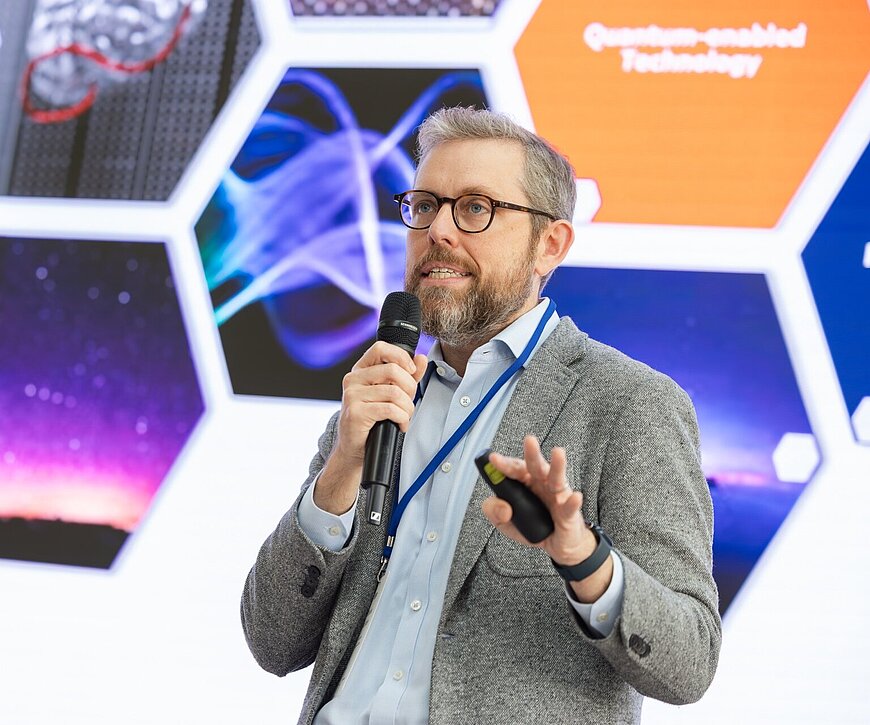

At Blue Magic NL, Thomas McSorley explains how NATO's DIANA aims to solve the process problem that stands in the way of defense innovation.
‘No one doubts the existence of the technology. No one doubts the availability of funding. And no one doubts the necessity,’ said Thomas McSorley, general legal adviser to NATO's Defence Innovation Accelerator for the North Atlantic (DIANA). ‘The real challenge is connecting supply and demand.’
During the Blue Magic Netherlands event in Eindhoven on 18 November, McSorley gave his diagnosis of the bottleneck in European defence innovation and how DIANA is trying to break through it.

From ideas to impact
DIANA, founded to serve as ‘NATO's innovation engine,’ now operates in London, Tallinn, Halifax, and Eindhoven with a network of more than 200 test centres, over 1,000 mentors, and accelerators stretching from the US West Coast to Ankara. The goal: to turn promising commercial technologies into deployable defence capabilities.
The programme's core mechanism is simple in theory: NATO publishes challenges that focus on effects, not hardware shopping lists. Start-ups and scale-ups respond with ideas; winners receive a £100,000 contract, not a grant.
The difference between the two is important, McSorley emphasises. A contract positions companies as actual suppliers from day one and gives them a clear path to NATO's procurement ecosystem. ‘We are not a grant-making agency,’ he said. ‘We are a contracting agency.’
Closing the adoption gap
McSorley repeatedly returned to NATO's biggest innovation problem: adoption. New technologies get stuck between proof-of-concept and actual purchase. DIANA's answer is the new Rapid Adoption Action Plan, which was approved by all 32 NATO leaders this summer.
For the first time, ideas developed through DIANA's challenge programme can be put into production directly in member states, without additional competition. Countries can choose to participate, finance prototypes, and if the technology performs well, NATO procurement agencies can purchase it for implementation.
Thomas McSorley, General Counsel of NATO's Defence Innovation Accelerator for the North Atlantic (DIANA) © Nadia ten Wolde
There are now five such opt-in programmes in place. ‘You can go from idea to delivery without leaving the ecosystem,’ says McSorley. ‘This is based on the best ideas within the alliance.’

Startups get more than just money
What DIANA really offers, according to McSorley, is an ecosystem: a mentoring network of technologists and military experts, curated access to test centres, and guidance on IP protection and compliance. The accelerator trains teams to navigate dual-use markets, a process that used to cause hesitation, but, as McSorley casually noted, ‘we don't feel much hesitation about working in the defence sector anymore.’
Companies also receive support in developing a strategy, particularly when they are invited to participate in military exercises. McSorley cautioned start-ups not to waste resources on demos that don't serve clear goals. ‘We've seen companies put a lot of capital into demonstrations that don't lead anywhere,’ he said. DIANA helps teams plan for return on investment and measurable results.
First signs of progress
From the first group alone, several companies have secured major contracts or opened new production facilities. One company received an investment from the NATO Innovation Fund. Other companies are developing quantum navigation, secure network equipment, smart grid technology and new possibilities for chip manufacturing.
According to McSorley, the defence revenues of the participating start-ups rose by 29% last year, and fundraising also increased. DIANA has also started offering €300,000 phase 2 contracts to the most promising companies.
The energy in Europe
Perhaps the strongest message was one of urgency. Now that NATO countries have committed to increasing their defence spending to 5% of GDP, the opportunities for innovators are enormous, but only if the ecosystem is well coordinated. ‘There is a lot of energy, especially in Europe,’ said McSorley. ‘What we don't want is for capital to flow in all directions and for people to lose patience. Let's work together to deliver what the alliance needs.’