Luxene makes dark roads safer with innovative lighting
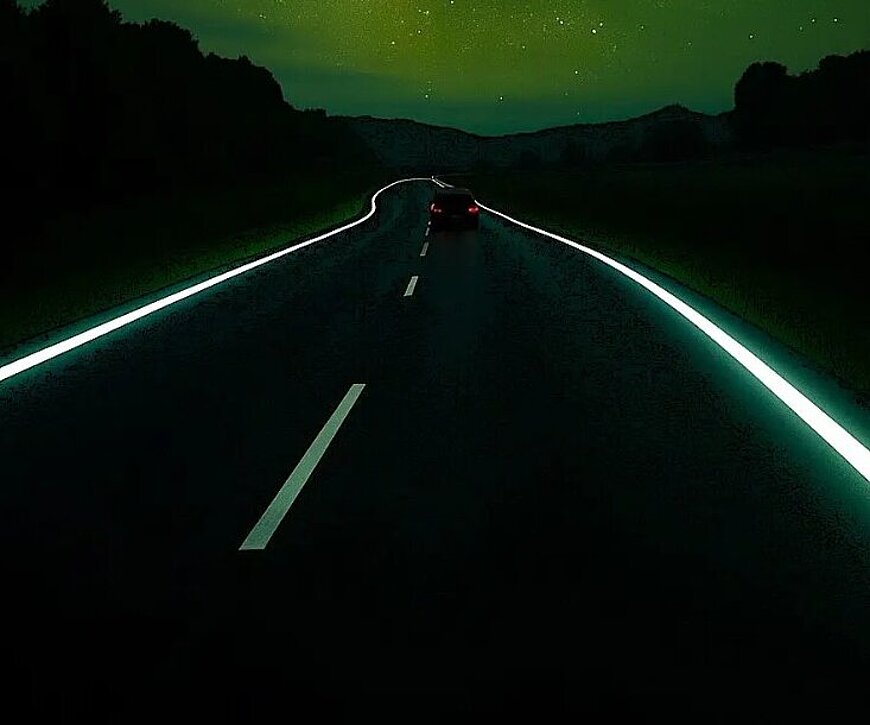

How can you ensure that people can move safely along dark roads and cycle paths without illuminating the entire surrounding area? Luxene, a start-up based in Brabant, is developing a technology designed to make precisely that possible. Using light lines based on laser light and fibre optics, the company makes routes visible, whilst the electronics remain separate from the road surface. Founder Maarten Tobias explains how a new application of existing technology is evolving into a solution with international ambitions.
A different approach to lighting
The idea for Luxene arose when the team discovered a technology in which fibre optics not only transmit light but can also emit it. This offers possibilities in places where electronics are vulnerable, for example due to moisture or vibrations.
At the same time, the team identified a challenge on dark roads and cycle paths. It can be particularly difficult to see where the road is, especially in the rain. Previous attempts to incorporate LED lighting into the road surface ran into technical limitations. Having the electronics embedded in the road made such systems vulnerable and high-maintenance.
Luxene therefore posed a different question: what if you did incorporate lighting into the road, but kept all the electronics and active components out of it? That idea formed the basis for the technology the company is developing today.
Light where it’s needed
Luxene’s solution combines laser light with special optical fibres. This creates a bright, continuous line of light that makes the route visible. The light source and electronics are located off the road. The light is guided to the right spot via optical fibres.
This approach enables a different form of lighting. Instead of illuminating the entire road, a cycle path and the surrounding area, only the route itself is marked. According to Luxene, this requires considerably less light and energy than conventional lighting. Furthermore, maintenance can be carried out more easily, as the active components remain outside the road surface. Consequently, the road does not need to be closed for maintenance work on these components.
The ambition goes beyond energy savings. The company aims to contribute to road safety whilst minimising light pollution for local residents, nature and wildlife.
“Ultimately, it’s about something very human: we want to ensure that people get home safely.” Maarten Tobias, founder of Luxene
From prototype to field trials
Infrastructure technology must not only work in a laboratory; it must also be able to withstand heavy traffic, rain, frost, heat and years of daily use.
That is why Luxene is testing the light lines at various locations. In Hedel, there is a pilot section of around twenty metres over which heavy goods vehicles drive every day. At the Automotive Campus in Helmond, approximately 200 metres of light line has been installed. According to the schedule for October 2026, this will be extended to 400 metres by the end of November.
In addition, Luxene has its own demonstration site in Helmond, where a total of more than 500 metres of light line has been installed. These field trials help the team to further improve the technology and investigate how the systems can be made reliable, affordable and easy to install.
At the same time, Luxene is working on the further industrialisation of the technology. For example, the company is developing dynamic control systems and an off-grid variant that can operate independently of the electricity grid. The team is also investigating applications in which light lines can contribute to the orientation and guidance of autonomous systems.
The first step towards commercial growth
Luxene is in the process of transitioning from technology development to commercial application. It has now secured its first contract from a Dutch local authority. In addition, the company is working on larger projects in the Netherlands and abroad.
According to the October 2026 schedule, Luxene expects to install its first major projects in early 2027. This brings the company closer to its next ambition: scaling up from tens and hundreds of metres to kilometres of light lines. The company also sees opportunities internationally. After all, the need for safe navigation on dark roads and cycle paths is not limited to the Netherlands. In many places, traditional lighting is not feasible or desirable, for example due to energy consumption, infrastructure costs or the impact on the environment.
Luxene’s development also received recognition in 2026. The start-up won the Intertraffic Start-up Award and secured a place in the KVK Innovation Top 100.
Nevertheless, for the team, the most important milestone lies not in winning an award, but in actual implementation. Only when road authorities and other parties put the technology into practice will Luxene be able to achieve its intended impact.
Working together to set a new standard
Luxene’s ambition is to establish orientation lighting – lighting specifically designed to make routes visible – as a new standard. This requires more than just technology that works well. In the infrastructure sector, safety, reliability and a long service life are key priorities. New applications must be extensively tested and validated before they can be rolled out on a large scale.
That is why collaboration with road authorities, public authorities and infrastructure companies, as well as the conduct of field trials, are key components of the growth strategy. Based in the Brainport region, Luxene is thus working on an application that combines technological innovation with road safety, energy savings and a liveable environment.
Brabant Startup Fund supports the move to market
The development of new infrastructure technology requires investment in research, prototypes and field trials. At the same time, it often takes some time before a technology has been sufficiently proven to be applied commercially on a large scale. The Brabant Startup Fund (BSF) supported Luxene at an early stage with a loan of €250,000. This funding gave the company the scope to invest further in the technology, the team and the demonstration of the light lines under real-world conditions.
This development has now translated into concrete interest and collaboration with public authorities, infrastructure companies and international partners.
“You have to be able to prove that something works before the market can adopt it on a large scale. BSF has helped us to bridge part of that crucial gap.”
BSF’s support is therefore helping Luxene through a crucial phase: the transition from a promising technological development to a product that can be applied on a larger scale.
Entrepreneurship means constantly testing and learning
For the Luxene team, the strength of entrepreneurship lies in the speed with which ideas can become reality. What’s on a whiteboard today could be a prototype tomorrow and, not long after, being tested out on the road.
That process doesn’t always go to plan. Materials sometimes turn out to be less suitable than expected, prototypes behave differently in practice, and technical choices have to be reassessed. It is precisely these experiences that help the team to keep improving the technology. Luxene therefore has a clear message for other entrepreneurs: don’t wait until a product is perfect, but get out there as soon as possible. Talk to potential customers, build prototypes and test your ideas in practice.
In doing so, it is important to look not only at the technology, but above all at the problem you want to solve with it.
“Technology is, ultimately, merely a means to an end. The real value only emerges when you create something that someone actually needs.”
For Luxene, this principle remains the guiding one. Through the further development and application of its light lines, the company aims to ensure that people can move around safely, without having to illuminate the entire surroundings.