AVOXT is making green hydrogen more affordable with new electrolysis- technology

Green hydrogen can play a key role in making industry, the chemical sector and heavy transport more sustainable, particularly in sectors where electrification is not always possible. However, large-scale adoption still faces a major challenge: high production costs. The Eindhoven-based start-up AVOXT is developing a new generation of electrolysers designed to make green hydrogen significantly cheaper. CEO Pascal van Bakel explains how a fresh perspective on existing technology led to a fundamentally different approach.
For Pascal van Bakel, his entrepreneurial journey began with a desire to make a social impact through technology. As a mechanical engineer, he saw a great deal of technical talent being channelled into problems where he felt the social added value was limited. Yet major challenges such as climate change actually call for smart technological solutions. He set out to find a way to apply his technical knowledge to the energy transition. That is how he came to focus on hydrogen.
A fresh perspective on existing technology
AVOXT was founded as part of HighTechXL’s venture-building programme in Eindhoven. Initially, the start-up worked with technology developed by CERN. Although this technology worked, its implementation proved complex and costly. The team realised that improving individual components would not be enough to make green hydrogen truly affordable.
AVOXT therefore decided to take a fresh look at the fundamentals of the production process. The focus shifted to the electrolysis cell, in which water is split into hydrogen and oxygen using electricity. In conventional electrolysers, these gases are separated by a membrane. AVOXT developed a technology that eliminates the need for this membrane. Instead, hydrogen and oxygen are discharged via separate liquid streams.
By omitting the membrane, a vulnerable component is removed from the system and internal resistance is reduced. Furthermore, the electrolyser can respond quickly to fluctuations in the availability of solar and wind energy. According to AVOXT, this approach can reduce the production costs of green hydrogen by around 40 per cent compared with conventional alkaline electrolysers.
“Industry will only truly make the switch if the sustainable alternative is also affordable.” Pascal van Bakel, CEO of AVOXT

From technological development to practical application
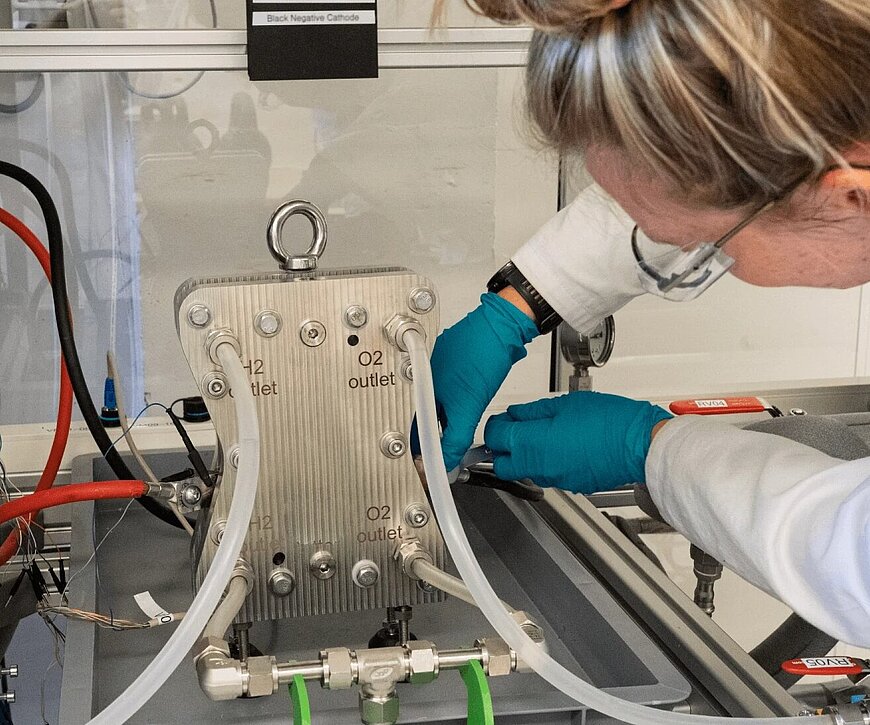
Having developed and tested various smaller electrolysis cells, AVOXT is now working on the next step: a complete electrolyser stack in which multiple cells work together. To this end, the team has built a test system in its own laboratory at the High Tech Campus Eindhoven that functions as a small hydrogen production plant.
The core technology has now been patented and the team comprises around thirteen staff members. The coming period will be focused on demonstrating that the technology also operates reliably on a larger scale and over a longer period of time.
An initial commercial pilot is already in the pipeline. In the Brainport region, AVOXT is working on a project for a fully off-grid community comprising around 140 homes. These homes will be equipped with, amongst other things, solar panels, batteries and heat pumps. Green hydrogen is intended to help store energy for times when the sun and wind do not provide sufficient electricity.
To this end, AVOXT is to supply an electrolyser with a capacity of approximately 150 kilowatts, with a targeted annual production of around 6,000 kilograms of green hydrogen. The project is currently in the next phase of the planning permission process. Completion is scheduled for the second half of 2027.
Scaling up step by step to industrial applications
Although the first practical application is aimed at residential properties, AVOXT’s ultimate ambition lies in industrial hydrogen production. The start-up has deliberately opted for a step-by-step approach.
Rather than developing large-scale industrial installations straight away, AVOXT is starting with smaller, decentralised projects in which hydrogen is produced and used locally. Think of sites where there is plenty of renewable electricity available, but where not all processes can be powered by electricity. Such applications may also be of interest in places where grid congestion hinders further electrification.
Through these projects, AVOXT aims to gain practical experience, further develop the technology and build trust with future customers.
In the longer term, the start-up aims to develop modular electrolyser stacks that can be combined to form megawatt-scale installations. This should make green hydrogen available on a larger scale for sectors such as the steel industry, the chemical sector and heavy transport.
Van Bakel is looking beyond the initial applications. He envisages a future in which green hydrogen is a natural part of the energy supply.
“If we do our job properly, in fifteen years’ time we’ll hardly be talking about green hydrogen at all. By then, we’ll simply be using it.”
Brabant Startup Fund supports AVOXT’s growth
Developing new technology requires not only technical expertise, but also funding and a clear path to market. Brabant Startup Fund (BSF) was one of the first investors in AVOXT and helped the start-up take its first steps towards scaling up.
The support went beyond funding. BSF helped the company to refine its market strategy. The ambition to make industrial hydrogen production more affordable remained, but the path to achieving this changed. By first developing smaller, decentralised applications, AVOXT can prove the technology in practice before the company moves on to larger industrial projects.
This approach also helps in discussions with new investors. According to Van Bakel, the involvement of a fund with knowledge of the Brabant deep-tech ecosystem has contributed to the further professionalisation of AVOXT.
Entrepreneurship starts with the problem
For Van Bakel, the appeal of entrepreneurship lies in the combination of speed, responsibility and social impact. Within a small team, ideas can be quickly turned into concrete experiments. An idea that arises in the morning can be tested in the laboratory that very afternoon.
This way of working requires flexibility and a willingness to let go of existing ideas. AVOXT has experienced this first-hand. By recognising that the original technology offered insufficient potential, space was created for a new solution.
According to Van Bakel, taking a fresh look at an existing sector can actually be an advantage. The AVOXT team questioned assumptions that were taken for granted by experienced specialists. That curiosity formed the basis for the membrane-free electrolysis technology.
He sums up his most important lesson for other entrepreneurs in a single sentence:
“Fall in love with the problem, not with your first solution.”
With this mindset, AVOXT continues to work from the Brainport region on the development of affordable green hydrogen. An ambition in which technological entrepreneurship and the energy transition converge.