‘Cultural differences, difficult? For me they are a fun challenge’
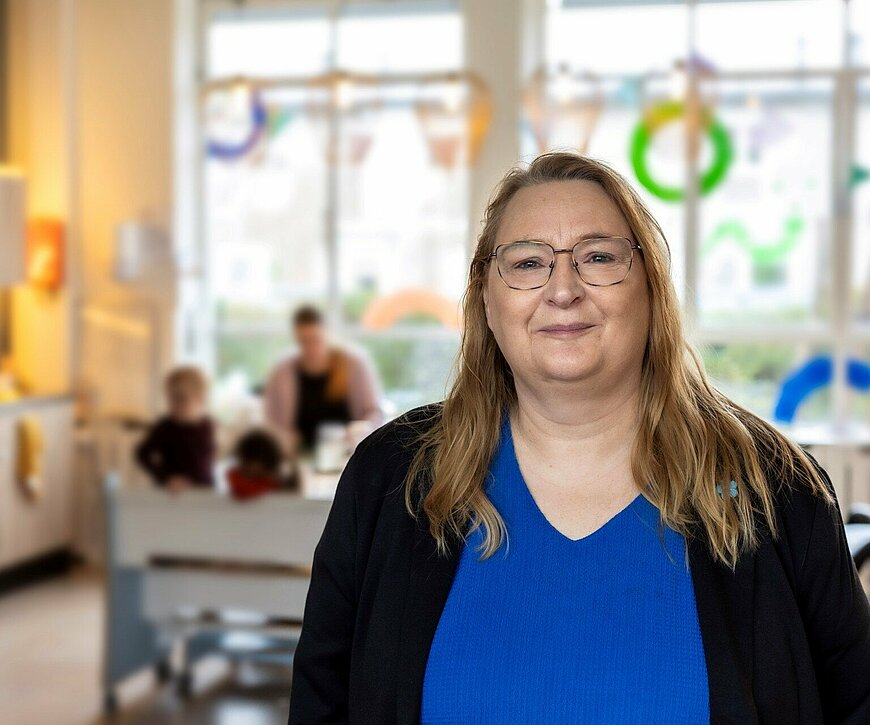
The Brainport region is becoming increasingly international. This offers opportunities, but also places demands on childcare facilities and primary, secondary and special education. That is why governments, the business community and educational institutions are working together to realise the same ambition: by 2027, the region will be organised in such a way that it can respond to the ever-fluctuating influx of international children. How are we doing this, and where are the opportunities and challenges? Educational staff, teachers, administrators and policymakers tell us more. This time: Ineke Sauerbier, educational staff member at Kids Society Erica.
Anyone who walks into the Kids Society Erica childcare organisation in Eindhoven will immediately see how diverse the children's cultural backgrounds are. “They come from all over the world. From India and Bangladesh to Turkey, Greece and Portugal,” says Ineke. “A large proportion of the parents are international knowledge workers and do not speak Dutch.” Ineke worked in Nuenen for a number of years, but wanted to work at the Eindhoven location. “I myself worked abroad at a young age, in French-speaking Belgium. That seems close, but you also have to deal with cultural differences. I know what it's like to partly understand the other person, but not understand everything. Just like the children and parents at our nursery. I find those language and cultural differences interesting. They offer me a fun challenge.”
Finding a balance between cultures
What kind of cultural differences does Ineke encounter? ‘Many children are not used to eating bread for lunch; they always eat a hot meal.’ But the biggest cultural difference is in sleeping patterns. ‘Children from countries such as India and Bangladesh often sleep with their parents for a long time. Of course, that’s not possible here. What’s more, these children often go to bed later than Dutch children. In these situations, I try to be mindful of the home culture, but also to say: this is how we do things in the United Kingdom. Finding that balance is challenging, but important. Someone’s parenting style is such a sensitive issue, I want to treat it with respect.’
Room for the home language
One way to honour the home culture is to allow the home language in the nursery. ‘When we have the theme “animals”, for example, I teach the children how to say cat or dog in Hindi, Portuguese or Greek. When I say those words, you see the children’s faces light up. It gives them a sense of recognition, which is wonderful to see.’ Ineke believes that allowing the home language is important for another reason. “The stronger your home language, the easier it is to learn a new language. I discovered this when I joined Van Alle Talen Thuis, a regional programme that promotes diversity and language development by offering multilingual book collections.”
Setting a good example
The reverse also happens: Ineke and her colleagues teach international children Dutch words. ‘The great thing is that we have children aged between zero and four in our group. Some already speak a little Dutch, others don't yet. That way, they also learn from each other.’ Ineke uses an example to explain why learning Dutch is already important. ‘You can imagine that playing with someone is difficult if you don't speak each other's language. How do you say: I want to play with that doll now? This kind of misunderstanding can lead to arguments.’ For Ineke and her colleagues, this means that they mainly set a good example for the children. ‘We play with them, guide them and help them communicate.’
Training employees ourselves
According to Ineke, working in such a diverse environment requires an open mind, but also simply enough colleagues. “That is perhaps the biggest challenge,” she says. “There is a significant labour market shortage. That is why we at Kids Society Erica have started training our own pedagogical staff. They can obtain their diploma within a year.” The childcare organisation is well aware of this challenge, but Ineke believes there is still room for improvement. “Contact with parents is often in English. However, some colleagues feel uncomfortable when they have to speak that language. It would be great if they could get help with that.”
More understanding for others
In her daily work, Ineke tries to familiarise international children and parents with Dutch culture. ‘For example, by explaining what the Sinterklaas festival is all about and where it comes from.’ At the same time, Ineke also learns from these children and parents. ‘It gives me even more understanding of other cultures. In the Netherlands, we can be polarising. But by respecting everyone, you can go a long way. I learn that every day.’
Regional Implementation Agenda for Internationalisation in Education
This article is part of a series of interviews with administrators and professionals from the childcare and education sectors. They talk about what internationalisation in education means to them and how they are working on the Regional Implementation Agenda.
This agenda focuses on the opportunities offered by the internationalisation of the Brainport region, but also addresses the pressure this puts on childcare and primary education. Together, we are working on appropriate and flexible educational provision for the various target groups, as well as on physical educational facilities. We ensure that all children feel welcome in the Brainport region and that all children can make the most of the opportunities our region has to offer.
You can download the agenda via the button below. For more information, please contact Mieke Zijlstra, programme manager, m.zijlstra@brainportdevelopment.
Regional Implementation Agenda for Internationalisation in Education