Shaping a circular future for advanced materials
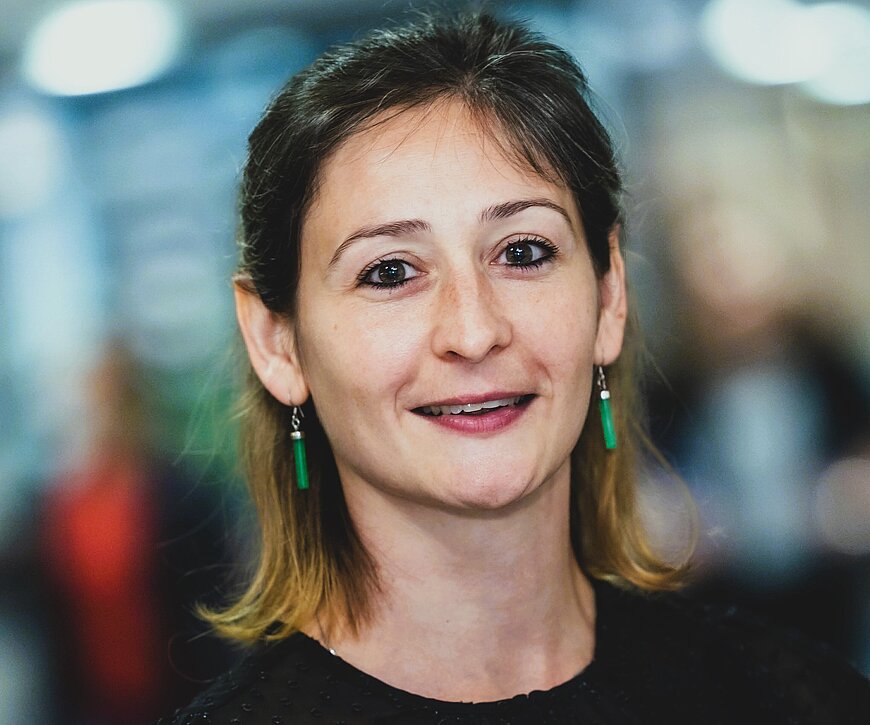
Coming from the south of France, with a PhD in Polymer Physics and Chemistry from the University of Nice-Sophia Antipolis, Amandine Codou first moved to Canada for a postdoctoral fellowship. There she focused on biobased composites for the automotive and agricultural sectors. After three years she wanted to broaden her impact and connect science more directly with industry. That search brought her to the Netherlands, where she joined TNO’s Brightlands Materials Center (BMC). Today, she works in the Sustainable Mobility program, combining expertise in mechanical recycling and additive manufacturing of thermoplastic composites (fiber-reinforced plastics).
“My work bridges science and industry. We help companies to make their production processes circular and to design materials that can be reused or recycled. Our ambition is to enable recycling of all fiber-reinforced plastics in Europe. This is a challenge across sectors, from automotive to sports, outdoor and furniture.”
Towards a circular economy
“At Brightlands Materials Center we apply the 4R approach: reduce, re-use, recycle, and recover. Our focus is mainly on reducing the amount of materials used, re-using components where possible, and recycling them into new structural materials when they are no longer fit for purpose. For example, if a car part has reached the end of its life, we study whether it can be reused in another way. If not, we develop technologies to recycle it mechanically into new high-performance materials. In this way, we keep plastics in circulation much longer and reduce waste streams.”
Scaling up technology
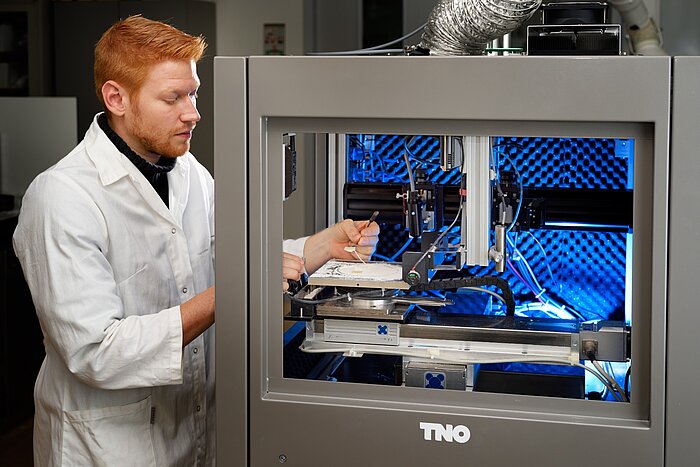
“When I started, our recycling lab was still in the making. Today, that lab is fully operational and growing. We can recycle up to 80 kilograms of material per hour and are working towards 100 kilograms. That capacity brings us a step closer to commercial-scale recycling technology, which can truly make an impact across Europe.
What I find particularly rewarding is working directly with industrial partners to recycle their production waste. Helping them to create zero-waste manufacturing is not just a technical challenge, it is also a cultural shift for companies. It shows them that circularity is not an abstract goal but something that can be built into their daily processes.”
Projects with real impact
“These advances are possible thanks to strong collaborations. Two projects that have been essential are the OPZuid Fieldlab Recycling and the Dutch ‘Groeifonds’ NXTGEN Hightech program. Both helped us to develop and expand our recycling capacity and flexibility in close collaboration with industrial partners.
Another great example is the SCOPAC project, where we created recycled transport pallets. These pallets not only can carry more goods per unit, but could also be recycled up to five times while still meeting performance standards. This significantly extend the lifetime of plastics. Achievements like these demonstrate that circularity is not only possible, but also competitive.”
A diverse and meaningful role
“My role is really diverse. It ranges from acquiring and managing projects, to supervising research engineers and students, to publishing new findings and presenting them at international conferences. What makes me enthusiastic is to see our recycling technology applied in real-world solutions and delivering tangible impact, whether that’s scaling up recycling recipes, validating a new material, or proving that waste can be turned into valuable resources."
I enjoy that my work allows me to use my knowledge for a wide variety of customers, each with their own challenges. It keeps me sharp and makes my job very dynamic. Every day brings something new.
Living and working in Eindhoven
Amandine and her Dutch partner decided to settle in Eindhoven, where they now raise their two children. “Living here is very enjoyable. Eindhoven offers all the facilities of a city, yet nature and parks are only a bike ride away. It’s a comfortable place to raise kids, while still being at the heart of a vibrant, international region.
Eindhoven is also very well connected, both by road and public transport, and with its own airport. I can easily fly to Nice to visit my family, which makes a big difference for me. The international character of the city also helps: many tech companies are here, and it is easy to collaborate and connect.”
An international, family-friendly city
“Moreover, Eindhoven houses a high concentration of tech and IT companies which makes it a very international city. Everyone “Eindhoven has grown into a very international place. It is open to the world, with a concentration of technology and IT companies that attract people from everywhere. For us as a family, it means we enjoy the cultural diversity, the many restaurants, and the great food cultures — places like the Down Town Gourmet Market are some of my favorites. The balance of international opportunities and local comfort makes Eindhoven truly special.”
Easy to settle in
“Moving here was straightforward — no work permit needed for EU citizens, English is widely spoken, and the community is welcoming. For internationals considering the move: I can only encourage you. Eindhoven is a growing city, open to the world, with countless opportunities to work, learn and connect. For me, it has been the ideal place to combine a meaningful career with a good quality of life.”