‘I learn words from the children's home language, because that makes them feel safe.’
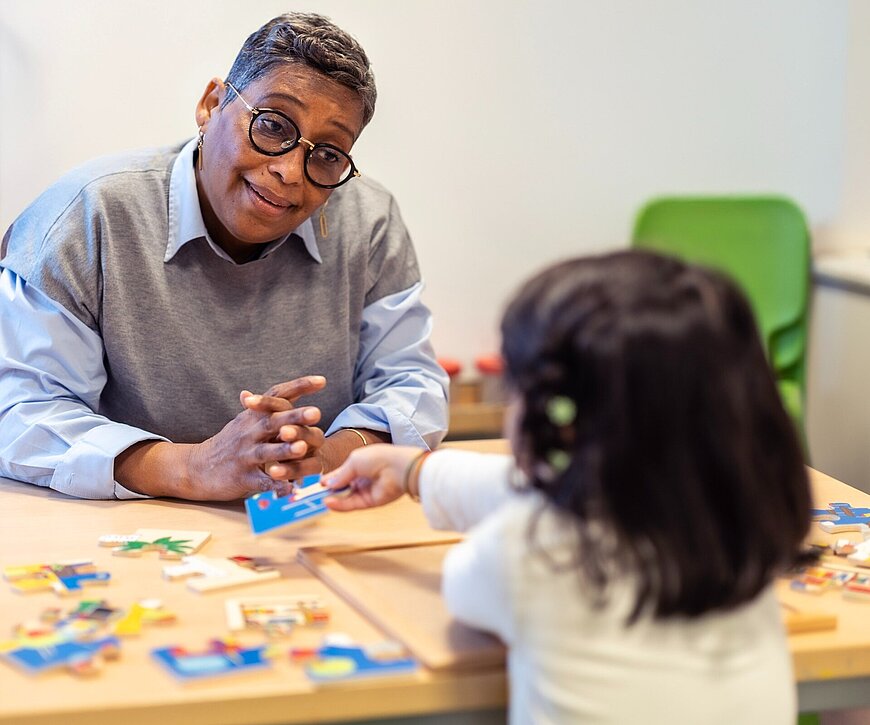
The Brainport region is becoming increasingly international. This offers opportunities, but also places demands on childcare facilities and primary, secondary and special education. That is why governments, the business community and educational institutions are working together to realise the same ambition: by 2027, the region will be organised in such a way that it can respond to the ever-fluctuating influx of international children. How are we doing this, and where are the opportunities and challenges? Educational staff, teachers, administrators and policymakers tell us more. This time: Susette Victoria, educational staff member at Korein Kiplinglaan in Eindhoven.
“When my children were attending nursery here, you could count the multilingual children on one hand,” says Susette, who has been working as a pedagogical staff member at Korein for twelve years. “Now, in my group of sixteen toddlers, you can already see seven different nationalities. Nine, if I count myself and my colleagues.” Susette is from the Antilles, but came to the Netherlands when she was 21. “My mother's parenting style was different from that of the average Dutch person. Now that experience helps me in my work. I understand parents from different cultural backgrounds just a little better.”

More independent and assertive
Susette cites the degree of independence of children as an example. “In the Netherlands, there is a lot of emphasis on this. Children learn early on to make their own sandwiches or take off their coats themselves. Parents from different cultural backgrounds are not used to this. They will, for example, unzip their coats for them.” Another example: according to Susette, Dutch children are more assertive. ‘They are encouraged to have their own opinions, make their own choices and stand up for themselves. In my upbringing, the emphasis was much more on obeying and behaving ‘properly’. This is also the case in many other cultures. It is important that parents and children from different backgrounds also learn Dutch values. This helps them to better understand the education system here.’
Knowing who you are
Nevertheless, Susette believes there should also be room for one's own culture. “I have always thought it important for my children to know who they are. In their case, that includes Antillean culture and the Papiamento language.” The home culture and language of the children in her group are therefore welcome at the nursery. ‘In fact, I often ask parents for important words in their language, such as ‘mummy’, ‘daddy’, ‘home’ or ‘toilet’. I then learn these words so that I can communicate a little with the child. That creates a feeling of security. At Korein, we think that's important. Only when a child feels safe do we focus on language stimulation. Because that's when they can start to develop.“ This is done, for example, by letting toddlers play with children in group 1/2 of the neighbouring primary school. 'That way, they hear Dutch from children who are further along in their language development. That helps them pick up new words.”

Focus on the mother tongue
Susette believes that it is important for multilingual children to develop not only their Dutch, but also their mother tongue. That is why she holds a reading hour in Hindi with Indian parents every two weeks. “We want to expand this. Think of a Turkish reading hour. Reading aloud in the home language not only gives a feeling of security, but if a child has a good command of their mother tongue, they can also learn Dutch more easily.”
All these different cultures under one roof are very rewarding for Susette. “Of course, I have my own values and standards, but here I realise every day that they are not the norm. I am learning to put myself in other people's shoes, with an open mind. What is important to them? And what belongs to which culture? This gives me a better understanding of others and parents are starting to trust me more and more. That's great, because we both want the same thing: the best for the child.”
Not afraid of the future
Susette expects the number of international children to continue to increase in the coming years. ‘That demands more from us as educational staff. We have to tailor our approach to each individual child. It is important that we immerse ourselves in multilingualism and the English language. If even more multilingual children arrive, it will be quite challenging. At the same time, I am not afraid of the future. I have learned that there is always a solution. We will find it by continuing to discuss this with parents and colleagues in the workplace.’
Regional Implementation Agenda for Internationalisation in Education
This article is part of a series of interviews with administrators and professionals from the childcare and education sectors. They talk about what internationalisation in education means to them and how they are working on the Regional Implementation Agenda.
This agenda focuses on the opportunities offered by the internationalisation of the Brainport region, but also addresses the pressure this puts on childcare and primary education. Together, we are working on appropriate and flexible educational provision for the various target groups, as well as on physical educational facilities. We ensure that all children feel welcome in the Brainport region and that all children can make the most of the opportunities our region has to offer.
You can download the agenda here. For more information, please contact Mieke Zijlstra, programme manager, m.zijlstra@brainportdevelopment.